
The strange parties to inhale anesthesia of the early 19th century
Nitrous oxide was one of the first effective anesthetics discovered, but it did not always have that important use.

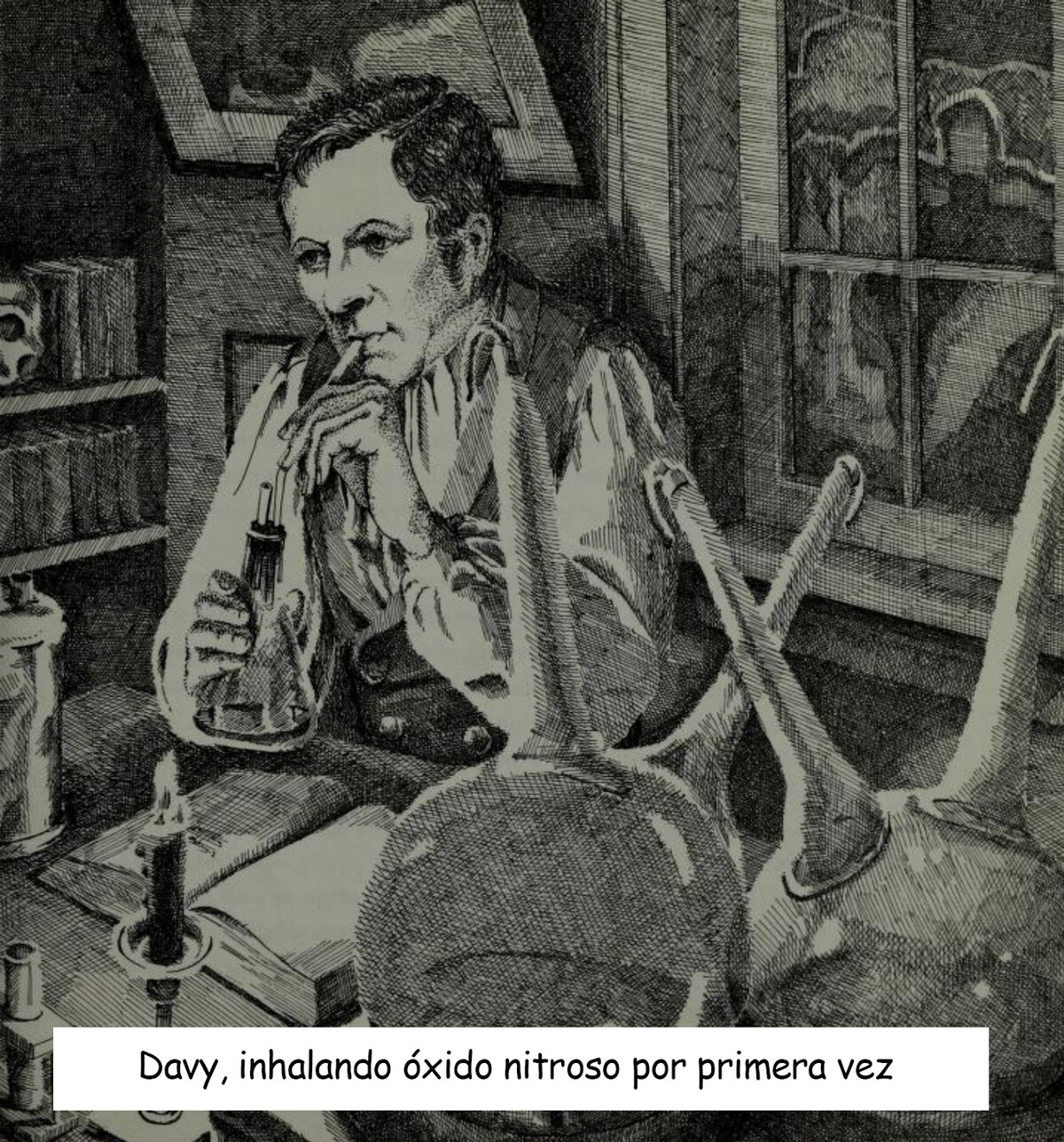
Nitrous oxide was one of the first effective anesthetics discovered, but it did not always have that important use. Several years after its discovery in 1772 by Joseph Priestley, it was found to have a laughter-inducing effect on those who breathed it. In fact, this property was first documented by Sir Humphry Davy, who dubbed it "laughing gas." Others would later nickname it "the gas of paradise."
For those unfamiliar with him, Davy was the discoverer of several elements such as potassium, sodium, barium, strontium, calcium and magnesium; besides being the father of electrolysis. Without a doubt, one of the great chemists in history. Davy became so interested in studying the relaxing effects of this gas that he ended up dependent on it: during his experimenting years he inhaled it up to 3 times a day. His health, undermined from a young age by years of inhaling experimental gases, never fully recovered.
Due to how relatively easy it was to produce it became popular in circus shows, to increase the jubilation of the public in the performances of comedians and clowns.
It did not take long for the most curious to attribute fantastic properties to it. Some believed that the mind, under the influence of the gas, could rise to a state of thought where the secrets of the Universe could be unmasked. Have you seen the movie "Limitless", where a guy becomes super smart after taking a transparent pill? ... well, more or less that was the hypothesis at that time. In fact, some scientists believed it very well and this must have reached the ears of the social elite of London at that time, since the so-called "laughing gas parties" were soon established.
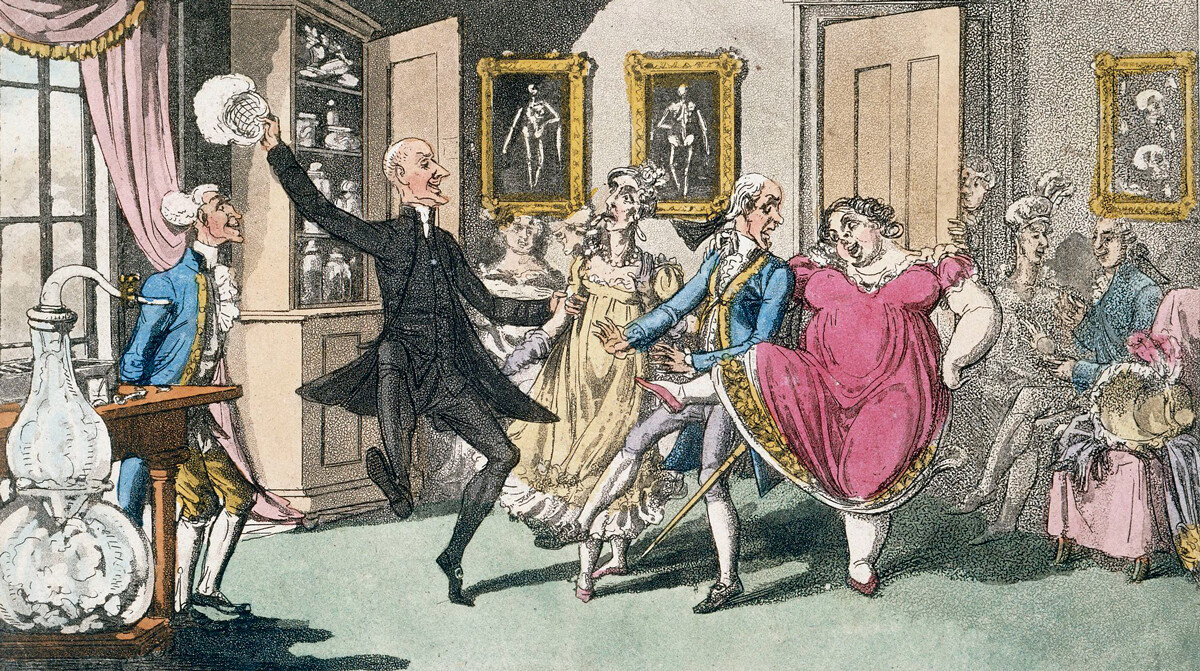
The parties became popular and were basically gatherings where gas bladders were filled and inhaled through the mouth, while pinching their noses with their fingers. The effects were almost instantaneous and somewhat unpredictable. The state of euphoria caused uproarious laughter, but not always, some broke down, others cried, some fought.
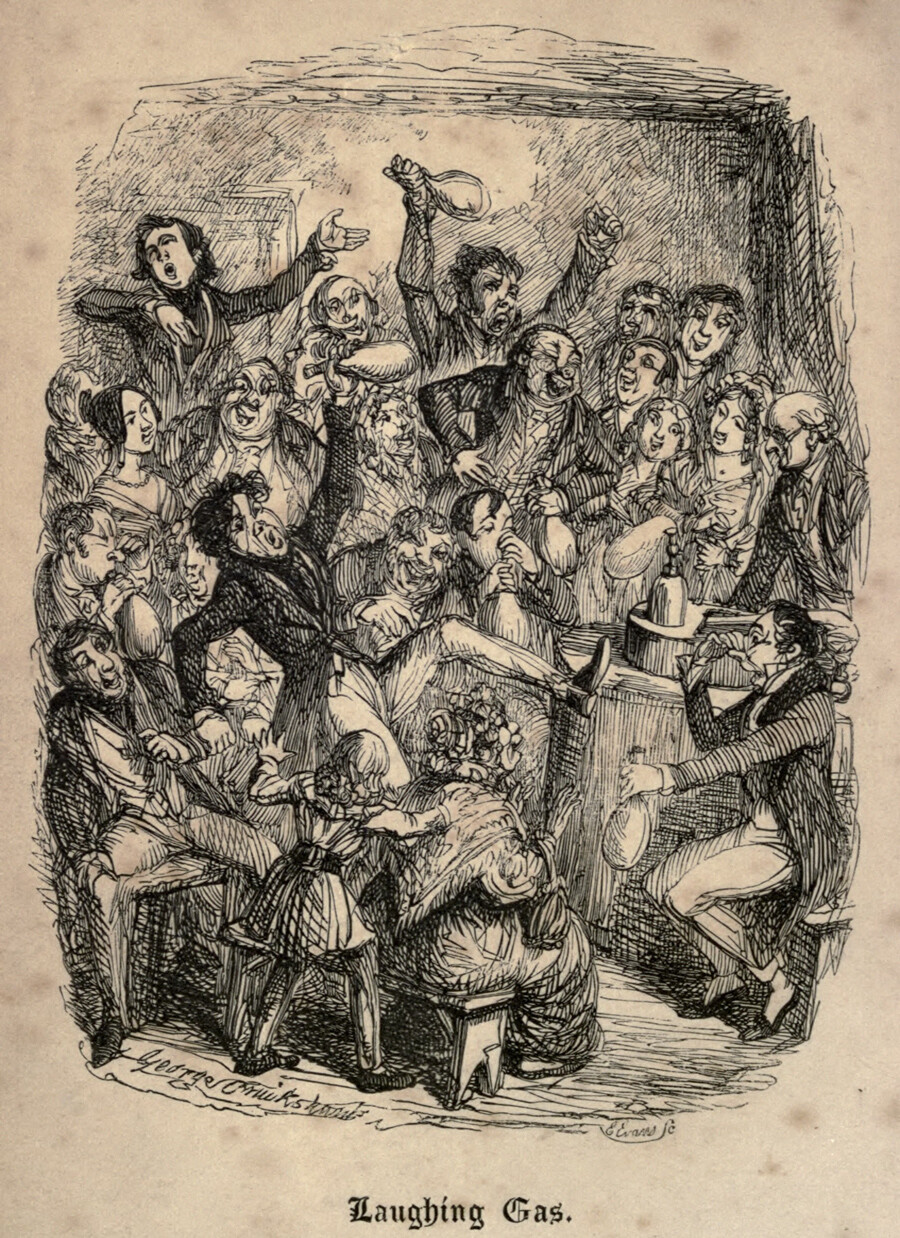
There were also public demonstrations of the effects of gas, where the attendees were the guinea pigs of these fun experiments. Many times important people volunteered to participate in these demonstrations, which were filled with onlookers. An interesting illustration appears on the first pages of an old book entitled Chemistry Without Mysteries, published in 1839. The illustration shows one of these presentations, where gas-filled bladders are distributed to the public.
The London newspaper "Morning Post" in 1819 recounted an experience during an exhibition held in Soho Square, where a young man in the audience offered to inhale laughing gas.
He laughed like a hyena, howled like a wolf, put his hands like an eagle's claw and leaped forward like a tiger. In the end, he crawled across the floor like a spider and ended up looking for his legs, unable to find them.
Important figures of science such as Michael Faraday (at the time Davy's assistant) or James Watt, tried the famous gas. Decades later, Winston Churchill himself would describe the hallucinations the gas gave him when he received it as anesthesia.
It was only in 1844 that its serious use as an anesthetic was proposed and has been used even to this day. Although Davy had proposed its use in surgery in 1800, it was an American dentist named Horace Wells who promoted its adoption as an anesthetic, when he fortuitously realized that a person under the influence of laughing gas had become numb to pain.
Recently, an escalation in the use of nitrous oxide as a recreational drug has been observed, mainly in Europe. Basically because in many countries it is sold freely. However, as we learned centuries ago, its use is not safe. The laughing gas parties could return, but this time we already know that it will not reveal the secrets of the Universe, and we know its potential risks of addiction.
References
- Humphry Davy, Researches, Chemical and Philosophical; Chiefly Concerning Nitrous Oxide, or Dephlogisticated Nitrous Air, and Its Respiration, London: J. Johnson, 1800. archive.org
- Horace Wells, A History of the Discovery of the Application of Nitrous Oxide Gas, Ether, and Other Vapors, to Surgical Operations, Hartford: J. Gaylord Wells, 1847. archive.org
- Mike Jay, The Atmosphere of Heaven: The Unnatural Experiments of Dr Beddoes and His Sons of Genius, Yale University Press, 2009. mikejay.net
Categories
The books · born from this blog

Atahualpa con su abrigo de pelo de murciélago
y otras 49 historias verdaderas que parecen mentira
Available on Amazon
Tocar madera
Pequeña historia de las supersticiones que el mundo no ha podido soltar
Available on Amazon
100 futuros
Cien escenarios del mundo que viene con la inteligencia artificial
Available on AmazonYou may also like
A 19th-Century Marketing Strategy: The Beautiful Collectible Cards of Liebig Meat Extract
A 19th-century marketing trick: how a meat extract turned a dreaded children's syrup into a craze with beautiful collectible art cards.

Knock on Wood: The Real Origin of the Superstition
Almost everyone thinks knocking on wood comes from Celtic tree worship. But the documented trail leads to a far more recent origin: a children's game.

Stockholm Syndrome Was Born to Silence a Hostage
The famous syndrome didn't come from a study: the police's own psychiatrist coined it to discredit a hostage who criticized him. It isn't in the DSM.