
Rhinoplasty: Plastic Surgery Is Older Than You Think
Rhinoplasty was born in India more than 2,500 years ago to rebuild noses cut off as punishment. That is how plastic surgery began.
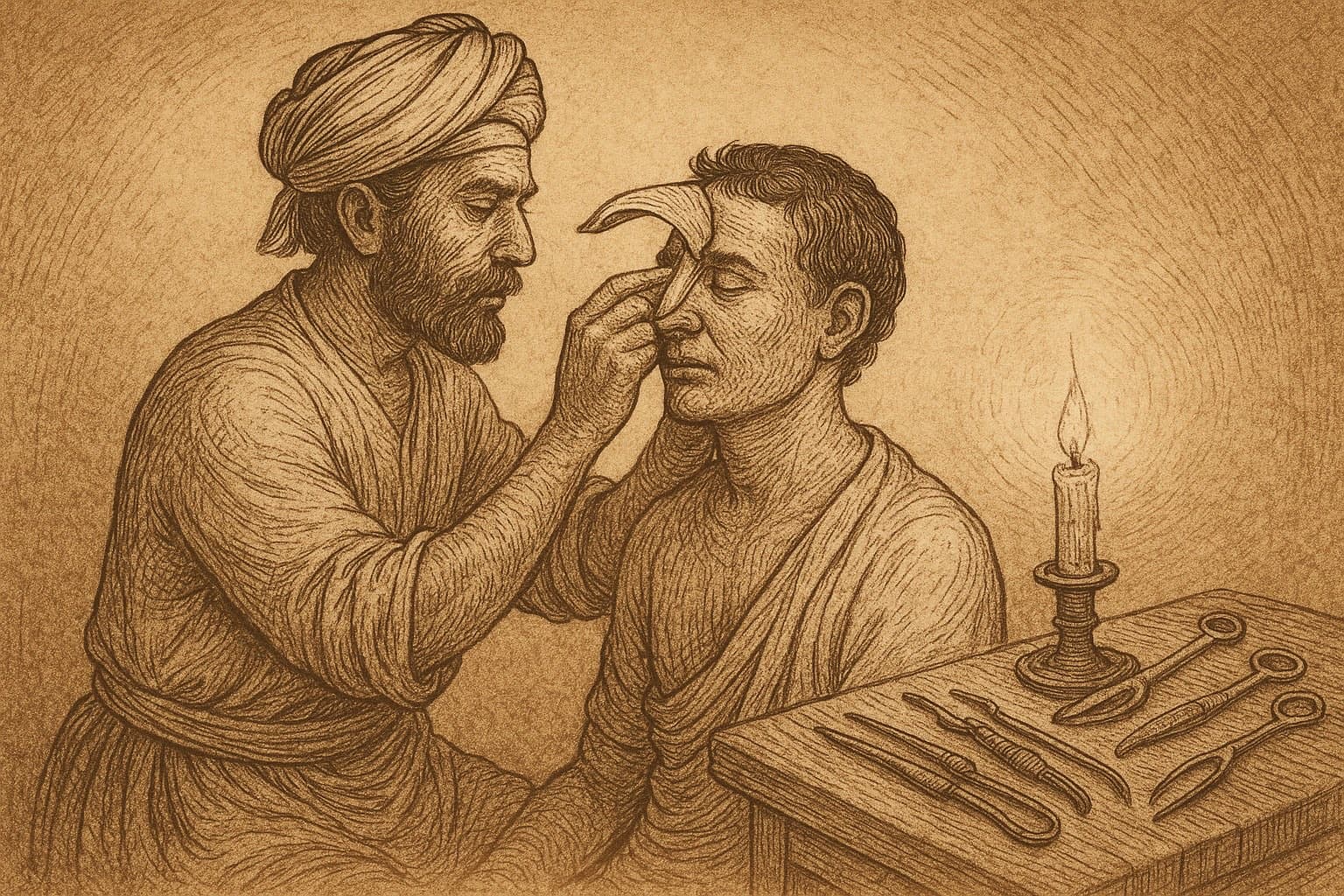
Few operations seem as much a product of our time as rhinoplasty: we associate it with celebrities, luxury clinics and the contemporary obsession with the mirror. Yet it is one of the oldest surgical procedures in the written record: it was already being performed in India more than 2,500 years ago. And its origin had nothing to do with vanity: it was born to give back a face to those who had lost theirs as a punishment.
India, the cradle of surgery
Hindu medicine is one of the oldest traditions in the world. Its central text, the Ayurveda (from ayur, “lifespan”, and veda, “knowledge”), understood health as the perfect balance of three bodily elements —air, bile and phlegm— and mixed philosophy with a vast arsenal of herbal remedies. But where Hindu physicians had no rival was surgery.
While in Europe operating was a barber's trade, in India surgery was a respected tradition, with an instrument kit astonishing for the time: scalpels, saws, scissors, forceps, probes and hooks. Apprentices trained by making incisions in gourds and leather bags, and by cutting the veins of dead animals: a school of experimental surgery that existed nowhere else in the world. To endure the pain —it would be more than two thousand years before anyone got serious about anesthesia— patients were given plenty of wine before going under the knife.
From that tradition came Sushruta, believed to have lived around the 6th century BC and now regarded as the father of surgery. The text that bears his name, the Sushruta Samhita, describes dozens of procedures in technical detail, among them an operation astonishing for any era: the reconstruction of the nose.
The punishment that created a specialty
Why did ancient India need to rebuild noses? Because of a terrible judicial custom: cutting off the nose was a common punishment for crimes such as theft and, above all, adultery. The nose was the seat of honor; whoever lost it was marked for life as a criminal, condemned to public shame. On top of that came the mutilations of war, so the demand for new noses was constant.
The solution Indian surgeons developed was so ingenious that it is still used today, with refinements: the forehead flap. A template was traced with a leaf over the stump, a tongue of skin was cut from the forehead —without fully detaching it, so it kept its blood supply—, it was folded down to cover the area and shaped into a nose, with reed tubes left in place so the patient could breathe. Weeks later, once the graft had taken, the bridge of skin joining it to the forehead was cut. The scar on the forehead was the price; the new nose, the miracle.
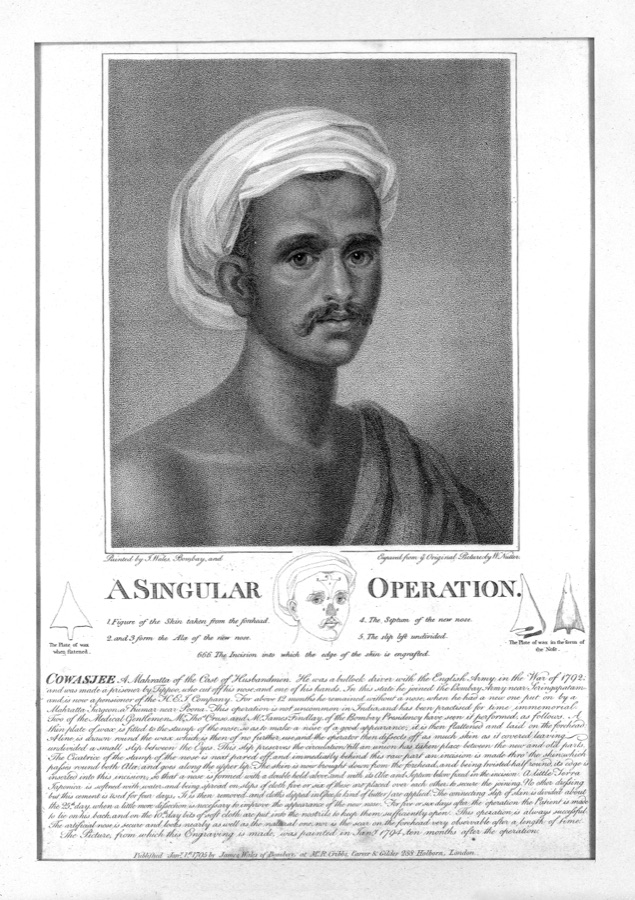
The technique was passed down for centuries as an almost secret family trade, until in 1794 it jumped into the European press. That year, the London magazine The Gentleman's Magazine published the case of Cowasjee, a bullock driver with the English army whose nose and one hand had been cut off by Tipu Sultan's men during the war of 1792. A surgeon from the potter caste rebuilt his nose with the traditional method, in front of two British physicians who could not believe what they were seeing. The engraving accompanying the case presented it as “a singular operation”, and that is how Europe discovered that India had been doing for centuries what its own surgeons could barely imagine.
The epidemic that brought rhinoplasty to Europe
In fact, Europe already had its own tradition, born of another epidemic of lost noses. In the late 15th century, syphilis spread across the continent like wildfire —each country named it after its enemy: the French disease, the Spanish disease, the disease of Naples—. In its advanced stages, the illness destroys the nasal septum and leaves the bridge sunken, the so-called “saddle nose”, as visible as a stigma. Among syphilis patients, duelists and soldiers, Renaissance surgeons found an abundant clientele.
One of the first was the German Heinrich von Pfolspeundt, who around 1460 described how to rebuild a nose with skin from the arm. He guarded his methods with an alchemist's zeal; he advised his disciples:
“If someone comes to you with a detached nose, let no one watch you, and make him swear he will tell no one how you cured him.”
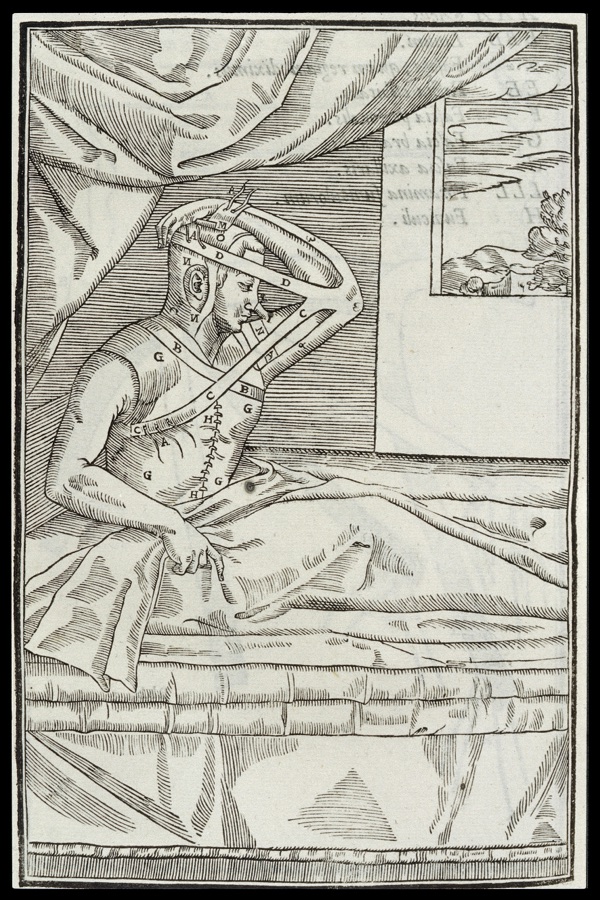
The undisputed master, however, was the Italian Gaspare Tagliacozzi (1545-1599), a professor at the University of Bologna. His arm-flap technique is as theatrical as it is effective: a tongue of skin was raised from the patient's forearm and sutured to the face —with the arm strapped against the head by a harness— for the weeks needed for the graft to take. Only then was the bridge cut, and the patient got back his arm along with a brand-new nose. His fame was such that, as the story went, he had a waiting list of forty patients. At the University of Bologna you can still see his statue, immortalized in a rather peculiar way: holding a nose in his hand.
After his death, legend has it, the Church —never a stranger to troublesome corpses— had his body exhumed from consecrated ground for having dared to play God by remaking faces. True or not, the anecdote says much about the uncomfortable place this surgery occupied: half miracle, half heresy.
The war that founded modern plastic surgery
The definitive leap came, like so many medical advances, on the back of a catastrophe. The First World War produced thousands of soldiers with faces disfigured by explosions and burns, men who could not return to civilian life looking like that. For them, the New Zealand surgeon Harold Gillies set up a hospital in England devoted entirely to facial reconstruction, where he performed thousands of operations and perfected the grafts and flaps that are commonplace today. That is why he is considered the father of modern plastic surgery.
The twentieth century did the rest: the motorized dermatome arrived, able to cut uniform sheets of skin of any desired thickness; the discovery of the epidermal growth factor made it possible to culture a burn patient's skin in the laboratory and reimplant it over their own lesions; and microsurgery made it possible to connect vessels and nerves under the microscope, to the point of reattaching amputated hands and feet.
And yet none of this would have begun without those anonymous surgeons of India who, twenty-five centuries ago, decided that a punishment did not have to be a life sentence. Today rhinoplasty is done in front of a mirror rather than by judicial decree —thankfully—, but deep down it is still what it always was: the surgery that gives people back their face. Not bad for a technique born in a punishment yard.
References
- Pedro Gargantilla, Historia curiosa de la medicina, Function, Kindle edition.
- “A Singular Operation,” The Gentleman's Magazine, vol. 64, London, October 1794. archive.org
- Sushruta Samhita, English translation by Kaviraj Kunja Lal Bhishagratna, Calcutta, 1907-1916. archive.org
- Gaspare Tagliacozzi, De curtorum chirurgia per insitionem, Venice, 1597. archive.org
Categories
The books · born from this blog
Atahualpa con su abrigo de pelo de murciélago
y otras 49 historias verdaderas que parecen mentira
Available on Amazon
Tocar madera
Pequeña historia de las supersticiones que el mundo no ha podido soltar
Available on Amazon
100 futuros
Cien escenarios del mundo que viene con la inteligencia artificial
Available on AmazonYou may also like
Rubber Before Goodyear: The Gum That Melted
Before vulcanization, rubber was a gum that melted in summer and cracked in winter. From the Maya to Goodyear, here's how it was finally tamed.
Porcelain: the Chinese secret Europe tried to steal
For centuries Europe paid fortunes for Chinese porcelain without knowing how it was made. This is the story of a hundred-year industrial espionage.
The History of Glass: The Material That Changed the World
Glass went from Egyptian luxury to everyday object thanks to Roman glassblowers, and later gave science its telescope and microscope.