
Chicle: the Maya resin behind your chewing gum
Chewing gum wasn't born in a factory: chicle was tree sap the Maya and Aztecs chewed for centuries before Wrigley ever wrapped it in pink paper.
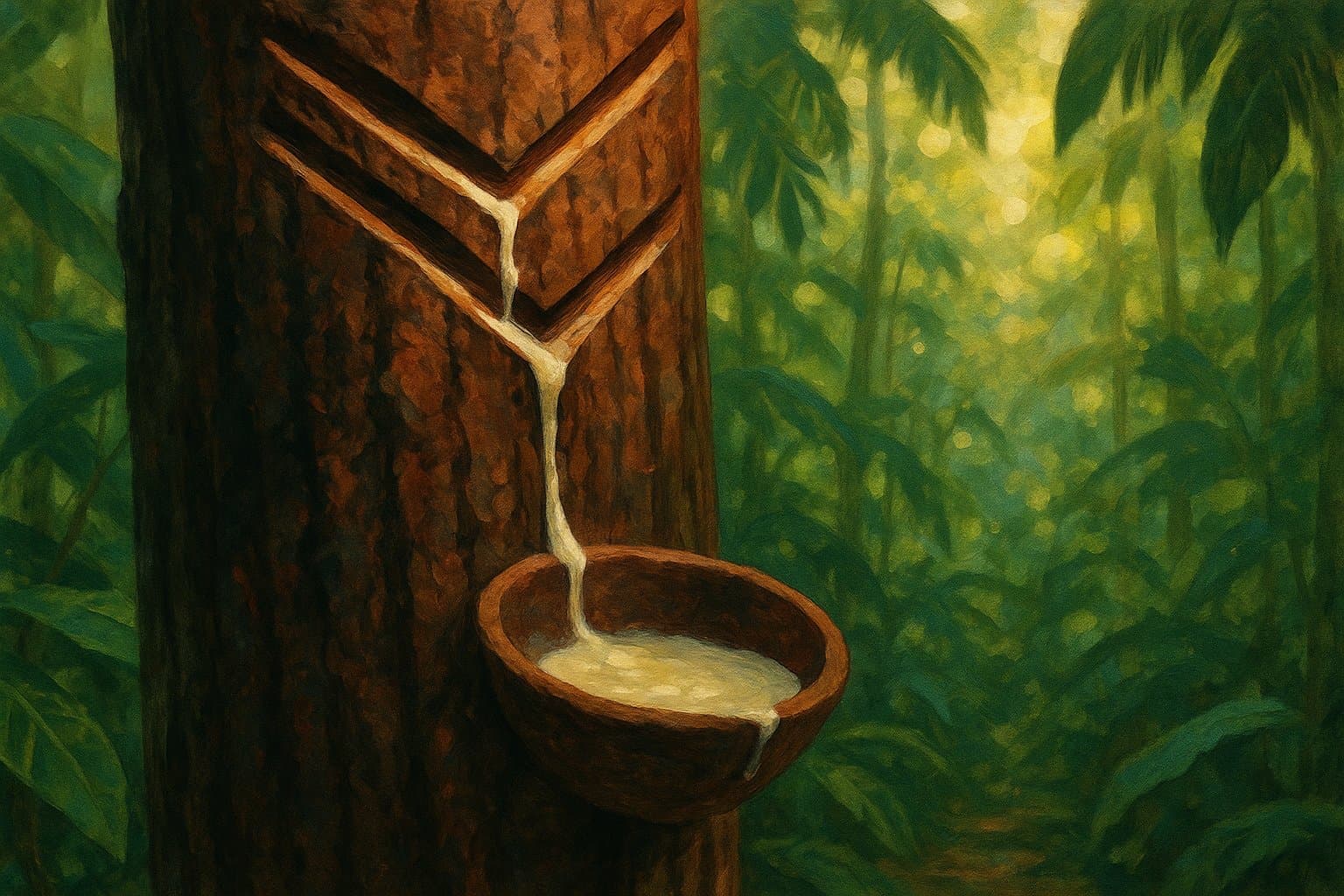
Before there were brands, pink wrappers and vending machines, chicle was simply this: the dried sap of a tropical tree. The Maya and the Aztecs were already chewing it centuries before an exiled Mexican general carried it to New York almost by accident. The chewing gum you buy in any shop today drags along a history that starts in the forests of Central America, runs through a failed attempt to make rubber, and ends —ironically— with barely any of the tree that gave it its name.
A tree that weeps latex: the sapodilla
The original chicle is the coagulated latex of the sapodilla tree (Manilkara zapota), a tropical species from southern Mexico, Guatemala and Belize. When you cut its bark, the tree oozes a milky, sticky sap that, once dry, turns into an elastic, chewable mass. It doesn't taste of mint or strawberry: it is practically flavorless, and that was exactly the point.
Mesoamerican peoples discovered that chewing it helped quench thirst, stave off hunger and clean the teeth. For centuries chicle sat somewhere between a habit, a hygiene tool and a social gesture. And like so many things from the pre-Hispanic world —from chocolate to the tomato—, it reached Europe and the rest of the planet through the language and hands of the people who already used it.
The Aztec rules for chewing gum
The curious part is that chewing gum in public was not a neutral act among the Mexica. The friar Bernardino de Sahagún, who documented Aztec culture in painstaking detail in the 16th century, noted that tzictli came with its own etiquette: girls and unmarried women could chew it openly, but married women and widows were expected to do so only in private, to freshen their breath, while a man chewing in public was frowned upon.
These nuances deserve some caution —colonial sources view Indigenous life through their own prejudices—, but the underlying idea is well recorded: chicle was not a children's candy but a substance with a precise place in social norms. Something similar happens when an everyday custom hides a whole hierarchy, as in the story of how different peoples decided what counted as money.
From «tzictli» to «chicle»: the word
The word chicle comes from the Nahuatl tzictli, the language the Aztecs spoke, and is usually translated as «sticky thing» or «that which sticks». Spanish adopted it as chicle, and from there it jumped into other languages almost unchanged. In English, in fact, the natural raw material is still called chicle, even though the finished product goes by chewing gum.
It is the same pattern many Indigenous words followed: when the Spanish ran into something they had no name for, they borrowed the local word. It happened with the first Taíno words from the Caribbean and, above all, with «chocolate» itself, another Nahuatl legacy that sounds nearly the same across half the world.
The general, the inventor and the rubber that never was
Chicle's leap from Mesoamerican curiosity to million-dollar industry has an unexpected protagonist: Antonio López de Santa Anna, the Mexican general and several-times president best remembered for losing Texas. Exiled and broke around 1869, Santa Anna arrived in New York carrying a plan to rebuild his fortune: he believed chicle could serve as a cheap substitute for rubber to make tires and other goods.
He teamed up with the American inventor Thomas Adams, who spent months trying to vulcanize the resin. The project was a total failure: chicle simply never behaved like rubber. But Adams had noticed something: people enjoyed chewing it. Instead of tossing the material, he boiled it, rolled it into little balls and began selling it as chewing gum. In 1871 he patented a machine to make it, and years later founded what would become the American Chicle Company. The rubber substitute had flopped; the chewing-gum business had just been born.
Wrigley and the boom that ate the trees
What turned chicle into a global phenomenon was marketing. In the late 19th century, William Wrigley Jr. understood better than anyone that the product sold on aggressive advertising and giveaways, and pushed his brand into millions of mouths. By the 1920s the average American chewed more than a hundred sticks of gum a year, and that demand had to come from somewhere: the forests of the Yucatán, the Guatemalan Petén and Central America.
That is where the chicleros worked, tappers who ventured into the jungle for months in search of mature sapodillas, scored the bark in zigzags with a machete and collected the latex trickling down the trunk. It was hard, dangerous work. And it was unsustainable: by 1930 the United States was importing some 15 million pounds of chicle a year, and the over-bleeding techniques used to boost yields ended up killing much of the tree stock, ravaging whole stretches of forest.
When chicle ran out of chicle
The final paradox arrived in the mid-20th century. In the 1940s, the industry began replacing the natural resin with synthetic gums derived from petroleum —waxes, plastics and artificial rubbers—, cheaper, more consistent and free of any tree that took years to recover. By the 1960s, most commercial chewing gum contained practically no real chicle at all.
So the next time you chew a piece of gum, it is worth remembering the irony: the word is still the same one the Aztecs used, but inside the wrapper there is almost never any sapodilla sap left. Genuine chicle survives today mostly as an artisanal product in southeastern Mexico, where a few chiclero cooperatives still bleed the trees the way they did centuries ago. It is the same story as so many materials that changed the world and were later swapped for lab-made versions, as happened with other resources that defined an era.
References
- «Chicle», Encyclopædia Britannica. britannica.com
- «A Brief History of Chewing Gum», Smithsonian Magazine. smithsonianmag.com
- «Chew on This: The History of Gum», History.com. history.com
- «Chicle», Wikipedia. en.wikipedia.org
Enjoy the stories behind words and objects? Continue with the Nahuatl we eat every day or explore the whole etymology series.
Categories
The books · born from this blog
Atahualpa con su abrigo de pelo de murciélago
y otras 49 historias verdaderas que parecen mentira
Available on Amazon
Tocar madera
Pequeña historia de las supersticiones que el mundo no ha podido soltar
Available on Amazon
100 futuros
Cien escenarios del mundo que viene con la inteligencia artificial
Available on AmazonYou may also like
The Origin of “Ñapa”: From Quechua to Lagniappe
Where does the word ñapa come from? From Quechua yapa, “something added.” The story of the market freebie that traveled to Louisiana and became lagniappe.
Cancha: from Inca enclosure to soccer field
«Cancha» comes from the Quechua kancha, the walled enclosure of the Incas. Here is how it went from temples and corrals to naming soccer fields across half the world.
Condor, puma and pampa: the Quechua we speak
Condor, puma and pampa come from Quechua, the language of the Incas. Here is how these and other Andean words reached Spanish, English and everyday speech.