
The origin of the word alcohol: from makeup to the glass
«Alcohol» comes from the Arabic «al-kuhl», a black powder used as eye makeup. How a cosmetic ended up naming the most famous drink in the world.
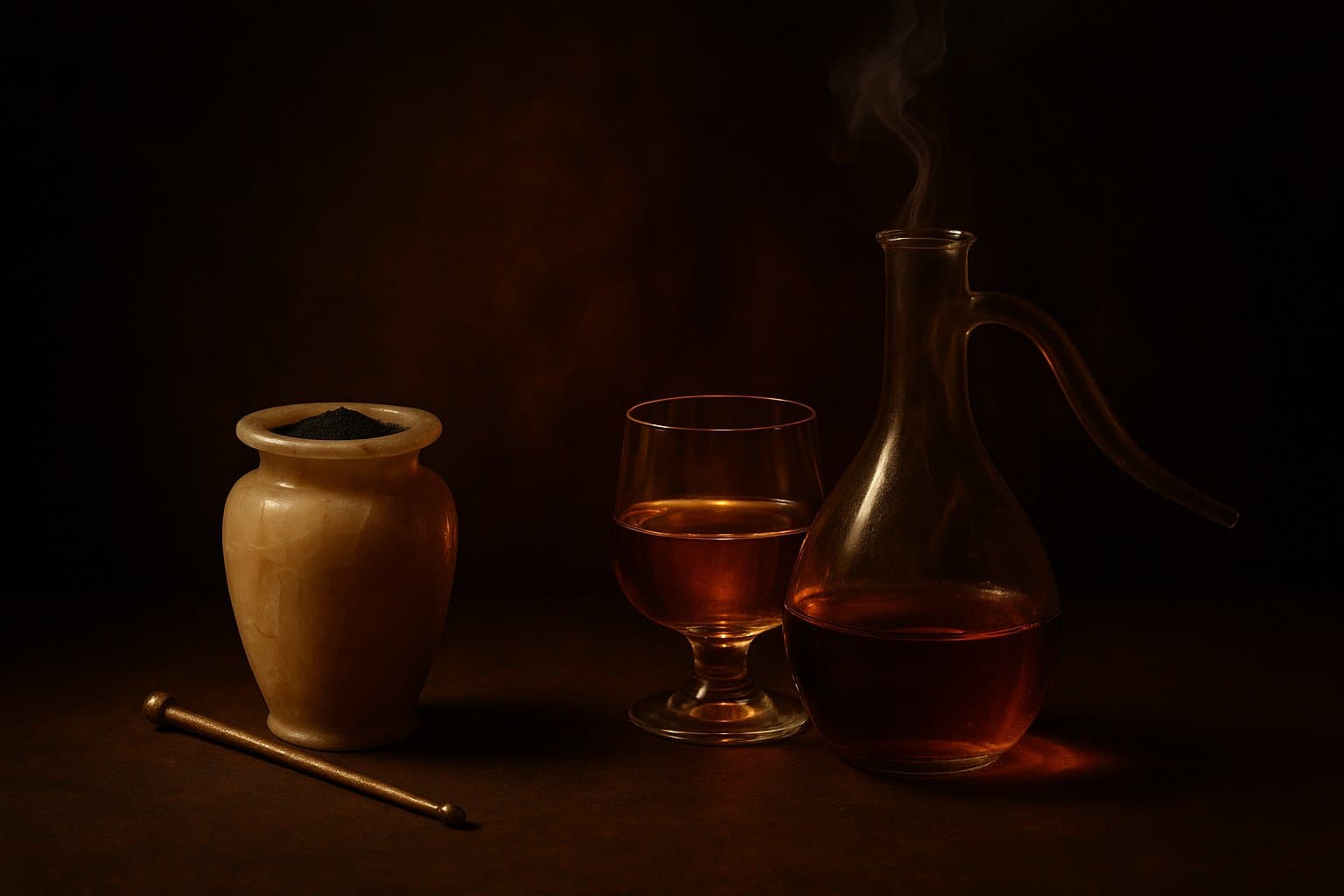
When someone orders a glass of alcohol, they are using —without suspecting it— the very same word with which the women of ancient Egypt painted their eyes. Nothing in the origin of this term has anything to do with getting drunk: the word «alcohol» was born naming a fine black cosmetic powder, traveled through the laboratories of alchemy, and only much later ended up stuck to the distilled drink. It is one of the longest and strangest shifts of meaning in our language.
A powder to paint the eyes
The starting point is the Arabic al-kuḥl (الكحل), where al- is the article «the» and kuḥl named a black powder of antimony sulfide —the mineral called stibnite— ground until it was impalpable. With that powder, known in English as kohl, people lined their eyes in Egypt, Mesopotamia and much of the ancient world. It was not merely cosmetic: it was credited with protecting the eyes from the glare of the sun and preventing infections.
The Semitic root k-ḥ-l has to do with «staining» or «painting» the eyes. So, at its origin, «alcohol» literally meant «the powder for makeup». The word entered the European languages with that cosmetic and chemical sense, not with that of a drink.
The Arabic legacy of science
That the word begins with al- is no accident: it is the fingerprint of Arabic on the European scientific vocabulary. During the Middle Ages, the scholars of the Islamic world preserved and expanded Greek knowledge, and when those texts were translated into Latin —above all in the Toledo of the translators— they dragged dozens of technical terms with them. From the same well came «algebra» (from al-jabr) and «algorithm» (from the name of al-Khwarizmi). «Alcohol» is a sister of those two: a word that reached Europe through the door of Arabic science.
And it was precisely in a laboratory —that of the alchemists— where the term began to change its skin.
From cosmetic to pure essence
The medieval and Renaissance alchemists ran into a practical problem: they needed a word for «the finest and most refined» part of a substance. And there was alcohol, which already named the most impalpable powder known, obtained by sublimation. By analogy, they began to call «alcohol» any extremely pure powder, and then any refined essence obtained by distillation. The word passed, little by little, from designating a solid to designating the purest and most volatile part of something.
The decisive step was taken by the Swiss physician and alchemist Paracelsus (1493–1541). He and his followers applied the term to the purest liquid they knew how to make: the distilled spirit of wine. Thus was born the Latin expression alcohol vini, «the alcohol of wine» —that is, the pure essence of the grape, just as al-kuḥl was the pure essence of antimony.
When «alcohol» climbed into the glass
For a while, «alcohol» on its own still meant «the sublimated essence of anything». As late as the seventeenth century people spoke of the «alcohol» of a metal or of a plant. But the phrase alcohol of wine was used so often that it kept getting shortened. By around 1753 the modern sense is already documented: «alcohol» alone to name the intoxicating ingredient of wine and other drinks. From there it spread to the intoxicating element of any fermented or distilled liquor.
The last link was added by modern chemistry. When scientists understood that this «spirit of wine» was a specific compound —ethanol— they generalized the ending -ol to name a whole family of similar substances: methanol, ethanol, glycol… The «alcohols» of chemistry are, deep down, distant descendants of an Egyptian cosmetic.
The ghost that wasn't: the myth of al-ghawl
There is an alternative etymology, much repeated online: that «alcohol» would come from al-ghawl (الغول), a demon or spirit of Arabic mythology —the same one behind the word «ghoul»— mentioned in the Qur'an as that which «clouds reason». The idea is seductive because it fits the feeling that drunkenness «possesses» you. But serious etymological dictionaries agree that the real origin is al-kuḥl, the powder for the eyes. The resemblance to the «demon» is a phonetic coincidence, not a shared root. It is the same kind of too-perfect legend that surrounds other words, like «nicotine» and its French ambassador.
From eyeshadow to the toast
Few words have traveled a road as long as this one. It began as the name of a black powder with which an Egyptian queen outlined her gaze; it passed through the hands of the alchemists as a synonym for «the purest thing»; Paracelsus poured it over the distillate of wine; and everyday use finally reduced it to what we understand today: the substance in a glass. Every time someone says «alcohol» they are pronouncing, without knowing it, a word that began in a makeup case of the ancient world.
References
- «Alcohol (etymology)», Etymonline. etymonline.com
- «Alcohol (chemistry) — Etymology», Wikipedia. en.wikipedia.org
- «Kohl (cosmetics)», Wikipedia. en.wikipedia.org
- «Does 'Alcohol' Come from Arabic Word for 'Body-Eating Spirit'?», Snopes. snopes.com
Do you enjoy the stories behind words? Continue with the origin of «algebra» or explore the whole etymology series.
Categories
The books · born from this blog
Atahualpa con su abrigo de pelo de murciélago
y otras 49 historias verdaderas que parecen mentira
Available on Amazon
Tocar madera
Pequeña historia de las supersticiones que el mundo no ha podido soltar
Available on Amazon
100 futuros
Cien escenarios del mundo que viene con la inteligencia artificial
Available on AmazonYou may also like

The origin of the word bikini: a nuclear explosion
«Bikini» comes from the Pacific atoll where the U.S. tested atomic bombs in 1946. A French designer named his swimsuit that way so it would be «explosive».
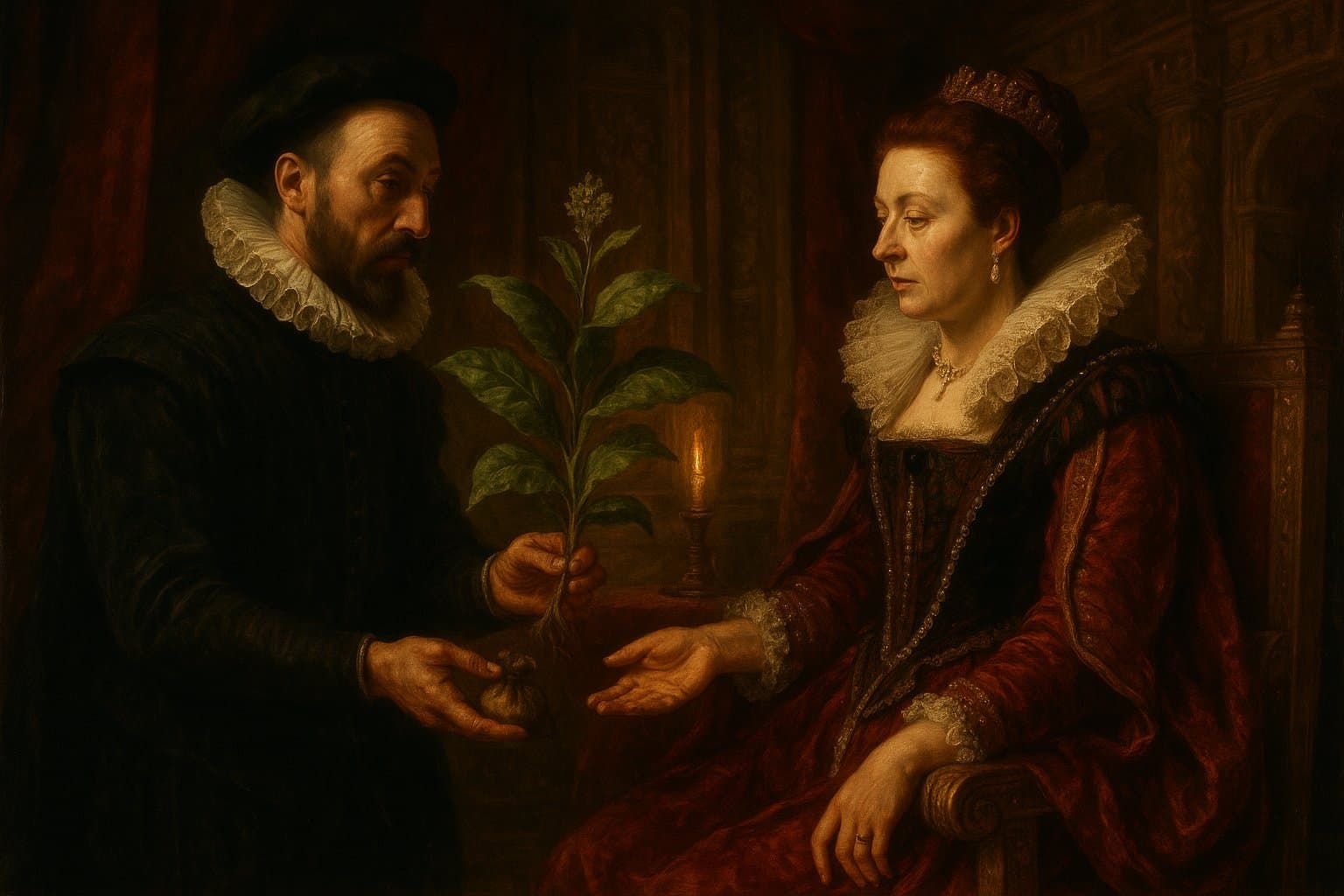
The origin of the word nicotine: a French ambassador
«Nicotine» comes from Jean Nicot, the ambassador who sent tobacco to Catherine de' Medici in 1560. How a surname ended up naming an addictive molecule.
The origin of the word sandwich: an earl and a table
«Sandwich» comes from the title of an 18th-century English noble. Legend says it was to keep playing cards; history hints at something duller.