
The origin of the word nicotine: a French ambassador
«Nicotine» comes from Jean Nicot, the ambassador who sent tobacco to Catherine de' Medici in 1560. How a surname ended up naming an addictive molecule.
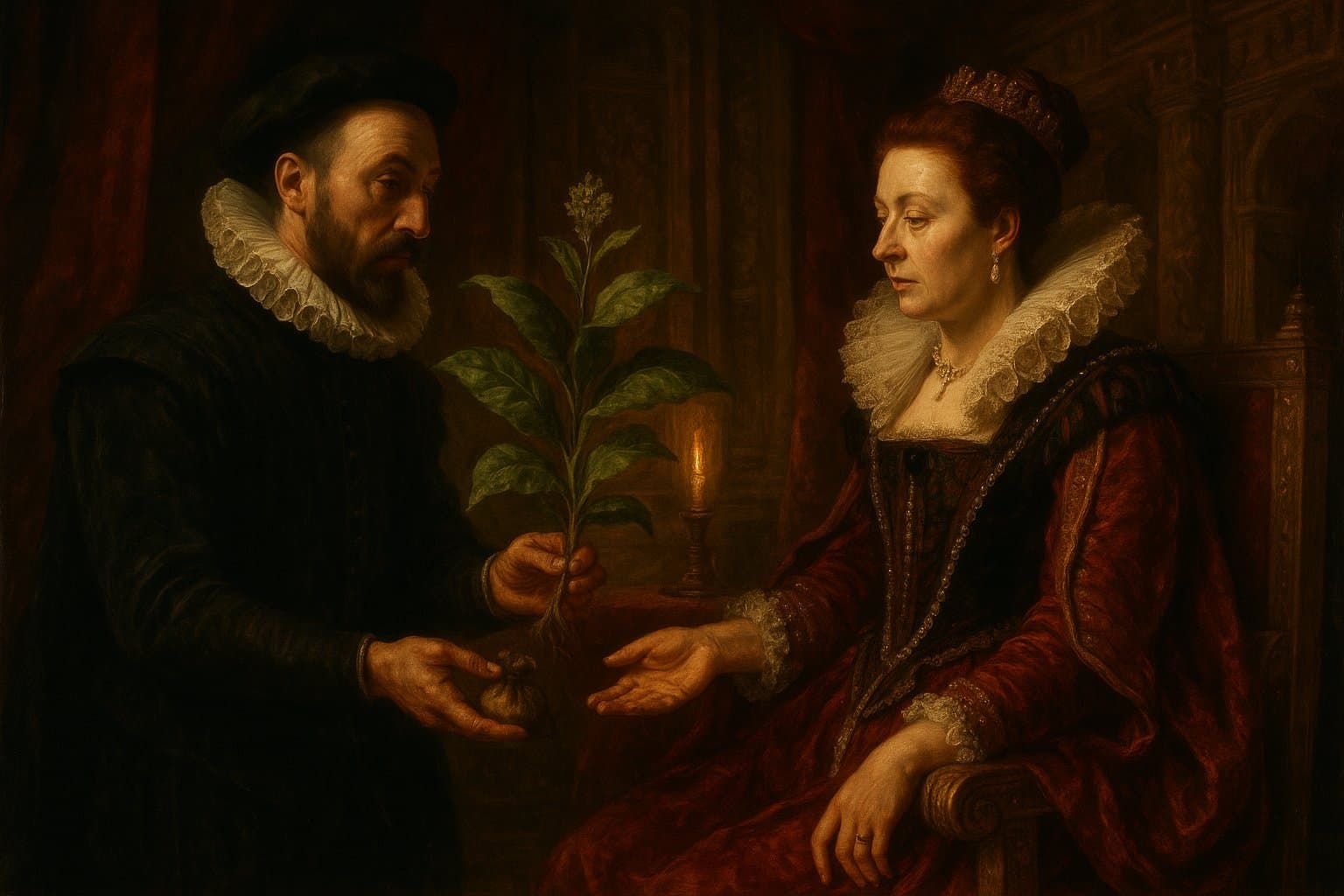
Every time someone talks about nicotine —the substance that hooks millions of smokers— they are pronouncing, without knowing it, the surname of a sixteenth-century French diplomat. He did not invent it, he did not discover it as a chemist, and he never smoked a cigarette as we understand one today. His achievement was different: he made tobacco fashionable at the most influential court in Europe and, as a side effect, lent his name to one of the most famous molecules on the planet. He was called Jean Nicot.
The ambassador who arrived in Lisbon
Jean Nicot de Villemain (c. 1530–1600) was born in Nîmes, in the south of France, and rose to become French ambassador to Portugal. In 1559 he was sent to Lisbon on a political mission: to negotiate the marriage between the very young Portuguese princess and the king of France. That negotiation went nowhere, but during his stay Nicot ran into something that would give him a fame no diplomatic errand ever could: a plant brought from the New World.
Tobacco had reached Europe not long before, carried by the Spanish and Portuguese navigators who had seen the peoples of the Americas use it. In Lisbon, a Portuguese humanist named Damião de Góis told Nicot about the supposed healing virtues of that exotic herb. Curious, Nicot decided to test it for himself.
The herb that "cured" everything
The story goes that Nicot tried a tobacco ointment on a man in Lisbon who had a tumor on his face, and became convinced the plant had improved it. From then on he saw it as an almost miraculous remedy: he believed it worked against headaches, ulcers, wounds, tumors and half a dozen other ills. In the sixteenth century, when medicine was largely trial and superstition, it was not unusual for a new plant to be sold as a cure-all. It was the same naïve enthusiasm for the "natural" that surrounded so many remedies of the age, centuries before the word «vaccine» was born from cows and medicine began testing its recipes with method.
Convinced he had found a therapeutic treasure, Nicot did what any ambitious courtier would do: he sent his discovery to the most powerful person he knew.
The gift to Catherine de' Medici
In 1560, Nicot dispatched tobacco seeds and powdered leaves to Paris, addressed to Catherine de' Medici, the queen mother of France, who at that point effectively ruled the country in the name of her sons. The queen suffered from severe migraines, and she was advised to inhale the powdered tobacco. According to the account, the remedy eased her pain —or so she believed— and from there tobacco became the latest fashion at the French court.
The success was such that the plant came to be called herbe à la Reine («the queen's herb») and also herbe à Nicot («Nicot's herb»). Sniffing powdered tobacco —snuff— became an elegant gesture, a mark of status that spread from the court to the whole European aristocracy. A diplomat who had failed at his official mission triumphed instead as the unwitting marketing agent of a drug.
From a surname to a scientific name
Nicot's surname stuck to the plant long before modern chemistry existed. In 1586, the French botanist Jacques Daléchamps gave it the Latin name Herba nicotiana. Almost two centuries later, in 1753, the great Swedish classifier Carl Linnaeus —the father of modern taxonomy— adopted that name to christen the whole genus of the plant as Nicotiana. And so tobacco was recorded forever in science with the echo of the ambassador inside it.
It is the same mechanism by which a proper name becomes an everyday word, as when a stingy French minister christened the «silhouette». Only here the leap did not stop at the plant: it was going to reach the molecule.
The molecule that inherited the name
The final step came in 1828, when two German chemists, Wilhelm Heinrich Posselt and Karl Ludwig Reimann of Heidelberg, managed to isolate for the first time the active compound of Nicotiana. They called it, as it could hardly be otherwise, nicotine. And they described it not as a miracle cure but as what it really is: a powerful poison. The irony closes the circle: the very substance Nicot promoted as a remedy turned out to be one of the most effective toxins and addictives known.
The chemical structure of nicotine was worked out in 1893 and successfully synthesized in the laboratory in 1904, but the name had been fixed for decades by then. From an ambassador's surname to the warning label on a cigarette pack, the word traveled almost four centuries without losing its root.
The echo of a name in every cigarette
Jean Nicot died in 1600 without suspecting that his true legacy would be neither his diplomacy nor the French dictionary he also compiled, but a molecule that millions of people would consume daily centuries later. His surname survives hidden in «nicotine», in «Nicotiana» and in every health warning about tobacco. Like so many words that began as a proper name —and as also happens with «assassin» and the legend of hashish— nicotine was worn down by use until no one remembered the man behind it. But there he remains, at the tip of every lit cigarette: the ambassador who made an American herb fashionable at the court of a queen.
References
- «Jean Nicot», Encyclopædia Britannica. britannica.com
- «Jean Nicot», Wikipedia. en.wikipedia.org
- «How did nicotine get its name?», Europeana. europeana.eu
- «Nicotine», Wikipedia. en.wikipedia.org
Do you enjoy the stories behind words? Continue with the origin of «silhouette» or explore the whole etymology series.
Categories
The books · born from this blog
Atahualpa con su abrigo de pelo de murciélago
y otras 49 historias verdaderas que parecen mentira
Available on Amazon
Tocar madera
Pequeña historia de las supersticiones que el mundo no ha podido soltar
Available on Amazon
100 futuros
Cien escenarios del mundo que viene con la inteligencia artificial
Available on AmazonYou may also like
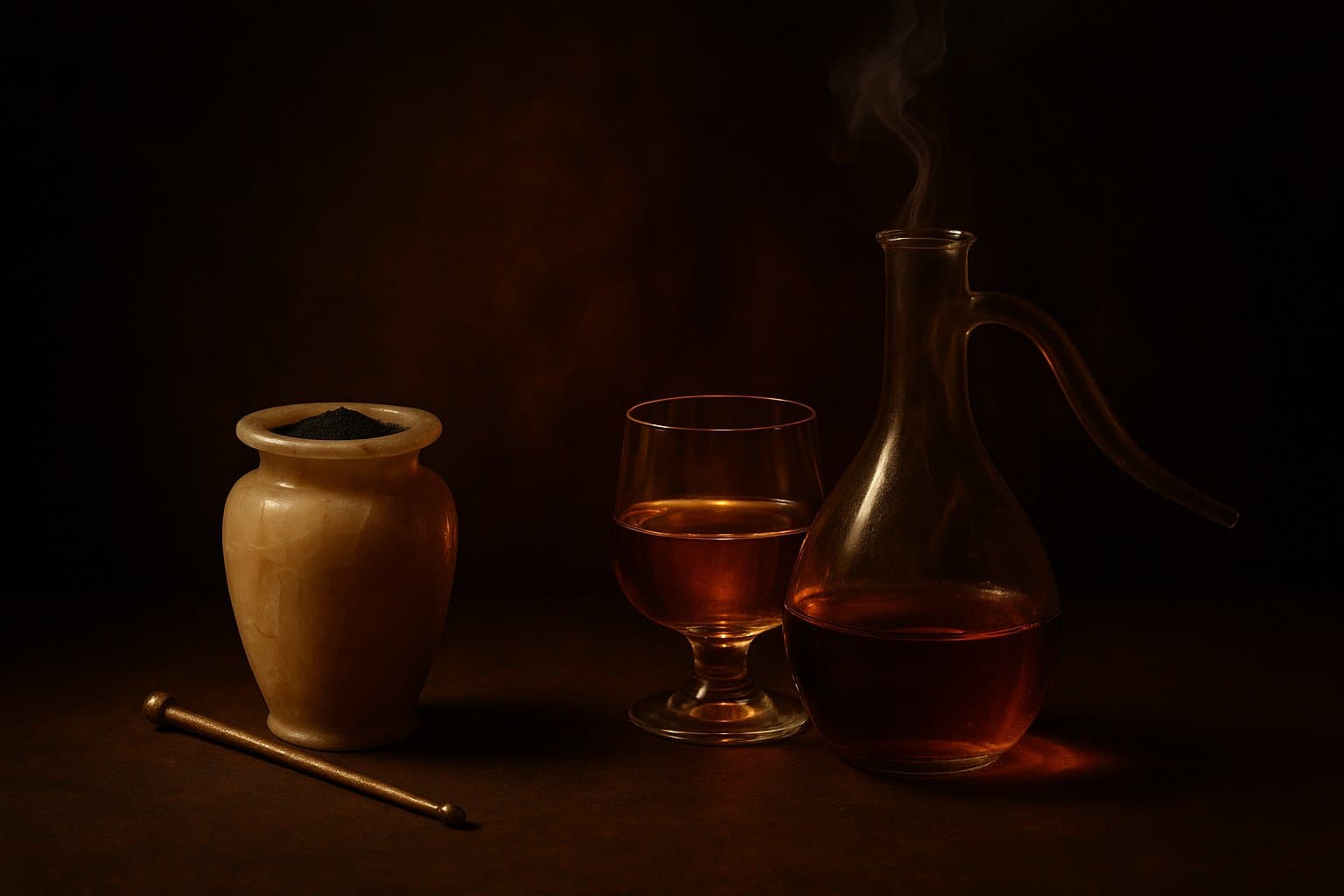
The origin of the word alcohol: from makeup to the glass
«Alcohol» comes from the Arabic «al-kuhl», a black powder used as eye makeup. How a cosmetic ended up naming the most famous drink in the world.

The origin of the word bikini: a nuclear explosion
«Bikini» comes from the Pacific atoll where the U.S. tested atomic bombs in 1946. A French designer named his swimsuit that way so it would be «explosive».
The origin of the word sandwich: an earl and a table
«Sandwich» comes from the title of an 18th-century English noble. Legend says it was to keep playing cards; history hints at something duller.