
Algebra: the Arabic word that also set broken bones
«Algebra» comes from the Arabic al-jabr, «to reunite broken parts». A book by Al-Khwarizmi gave birth to a science, and in medieval Spain an «algebrista» set bones.
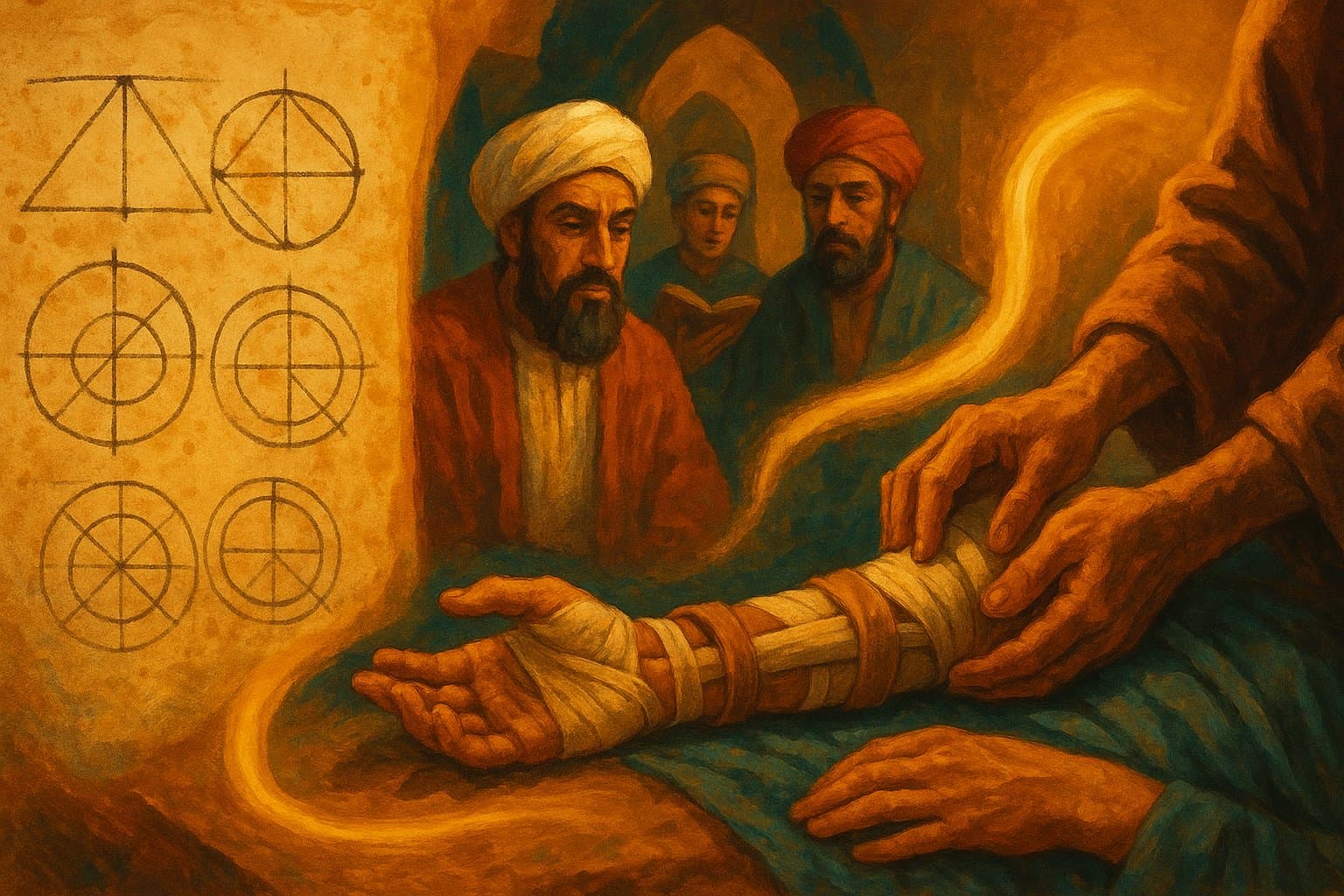
Millions of students wrestle with algebra every year without suspecting that the very same word, centuries ago, meant something quite different: to set broken bones. Before it stood for «solving equations», the Arabic root behind «algebra» described the gesture of a healer putting a dislocated bone back in place. The story of this word links ninth-century Baghdad, the barbershops of medieval Spain, and even a scene from Don Quixote.
A book written in Baghdad
Around the year 820, in the House of Wisdom in Baghdad, the Persian mathematician Muhammad ibn Musa al-Khwarizmi wrote a treatise with a long title: Al-kitab al-mukhtasar fi hisab al-jabr wa-l-muqabala, roughly «The Compendious Book on Calculation by Restoration and Balancing». From that book came the methods for solving equations we now call algebra, and from his own Latinized name —Algoritmi— another key word of mathematics was born, as we tell in the origin of the word «algorithm».
The decisive word in the title is al-jabr (الجبر). In Arabic it means «restoration», «completion» or, more literally, «to reunite what is broken». Al-Khwarizmi used it in a technical sense: when a subtracted term appeared in an equation, the method of al-jabr consisted of moving it to the other side by adding it —that is, «restoring» the equation until it was balanced.
From al-jabr to «algebra»
When Arabic texts began to be translated into Latin in medieval Europe —above all in the Iberian Peninsula, the frontier between the Islamic and Christian worlds— al-jabr was Latinized as algebra. The Arabic article al- («the») stuck to the word, just as it did with so many other Arabic loanwords that begin with «al-»: almohada (pillow), alcalde (mayor), alcohol. That is why in Spanish people say «el álgebra», unknowingly doubling an article that was already inside the word.
For centuries, «algebra» coexisted in Europe with its other, far more physical meaning. And that is where the story turns unexpected.
The «algebrista» who set bones
If al-jabr meant «to reunite what is broken», the metaphor leapt naturally from the realm of numbers to that of the human body. A fractured or dislocated limb also had to be «restored», each part returned to its place. So, in medieval and Renaissance Spain, an algebrista was not a mathematician: it was the specialist in resetting bones, a mix of healer and forerunner of the orthopedic surgeon.
The trade often went hand in hand with that of the barber-surgeon, who, besides cutting hair, drew blood, pulled teeth and splinted fractures. The Diccionario de autoridades, the first dictionary of the Royal Spanish Academy (eighteenth century), still recorded «algebrista» with this meaning: the person «who professes the art of setting dislocated or broken bones».
An algebrista in Don Quixote
The trace of that trade was engraved in the great Spanish novel. In the second part of Don Quixote (1615), after one of the knight's misadventures, Miguel de Cervantes mentions that an algebrista had to be found to tend a character's battered bones. No reader of the time would have been confused: it was not someone who solved equations, but the one who fixed dislocations and fractures. It is the same kind of drift by which a proper name or a trade ends up as a common word, as when a stingy French minister gave his name to the «silhouette».
The father of algebra… and of the algorithm
Al-Khwarizmi holds the rare honor of having lent his work to one word and his name to another. From al-jabr came «algebra»; from a Latinized Al-Khwarizmi came «algorithm». He was one of the figures who, together with Indian mathematics, helped introduce into the West the number system we use today, including the revolutionary idea of a symbol for nothing —a story we tell in why there is no year zero.
Arabic left an enormous layer of vocabulary in Spanish and in the sciences, especially in mathematics, astronomy and chemistry. Many of those words arrived with the same telltale prefix and with stories as curious as that of «assassin» and the legend of hashish, another word Europe inherited from the medieval Islamic world.
Two trades, one idea
Over time the bone-setting sense grew archaic and «algebra» specialized in mathematics, while «algebrista» came to mean someone who cultivates them. But the deep link is still there: both the mathematician and the old bonesetter were, at heart, doing the same thing. One restores the balance of an equation; the other, the integrity of a skeleton. Both reunite what is broken.
The next time someone rails against school algebra, it is worth remembering that the word was born from a mending gesture: putting each thing —a number or a bone— exactly where it belongs.
References
- «Al-Jabr», Wikipedia. en.wikipedia.org
- «Al-Khwarizmi», MacTutor History of Mathematics. mathshistory.st-andrews.ac.uk
- «Algebra: From Broken Bones To Twitter Feuds», Science Diction (WNYC). wnycstudios.org
- «algebrista», Diccionario de la lengua española (RAE). dle.rae.es
Do you enjoy the stories behind words? Continue with the origin of «algorithm» or explore the whole etymology series.
Categories
The books · born from this blog
Atahualpa con su abrigo de pelo de murciélago
y otras 49 historias verdaderas que parecen mentira
Available on Amazon
Tocar madera
Pequeña historia de las supersticiones que el mundo no ha podido soltar
Available on Amazon
100 futuros
Cien escenarios del mundo que viene con la inteligencia artificial
Available on AmazonYou may also like
The origin of the word alcohol: from makeup to the glass
«Alcohol» comes from the Arabic «al-kuhl», a black powder used as eye makeup. How a cosmetic ended up naming the most famous drink in the world.

The origin of the word bikini: a nuclear explosion
«Bikini» comes from the Pacific atoll where the U.S. tested atomic bombs in 1946. A French designer named his swimsuit that way so it would be «explosive».
The origin of the word nicotine: a French ambassador
«Nicotine» comes from Jean Nicot, the ambassador who sent tobacco to Catherine de' Medici in 1560. How a surname ended up naming an addictive molecule.