
Why Power Plugs Are Different in Every Country
There are about 15 plug types worldwide and voltages from 110 to 240 V. Here is why power plugs are so different from one country to the next.
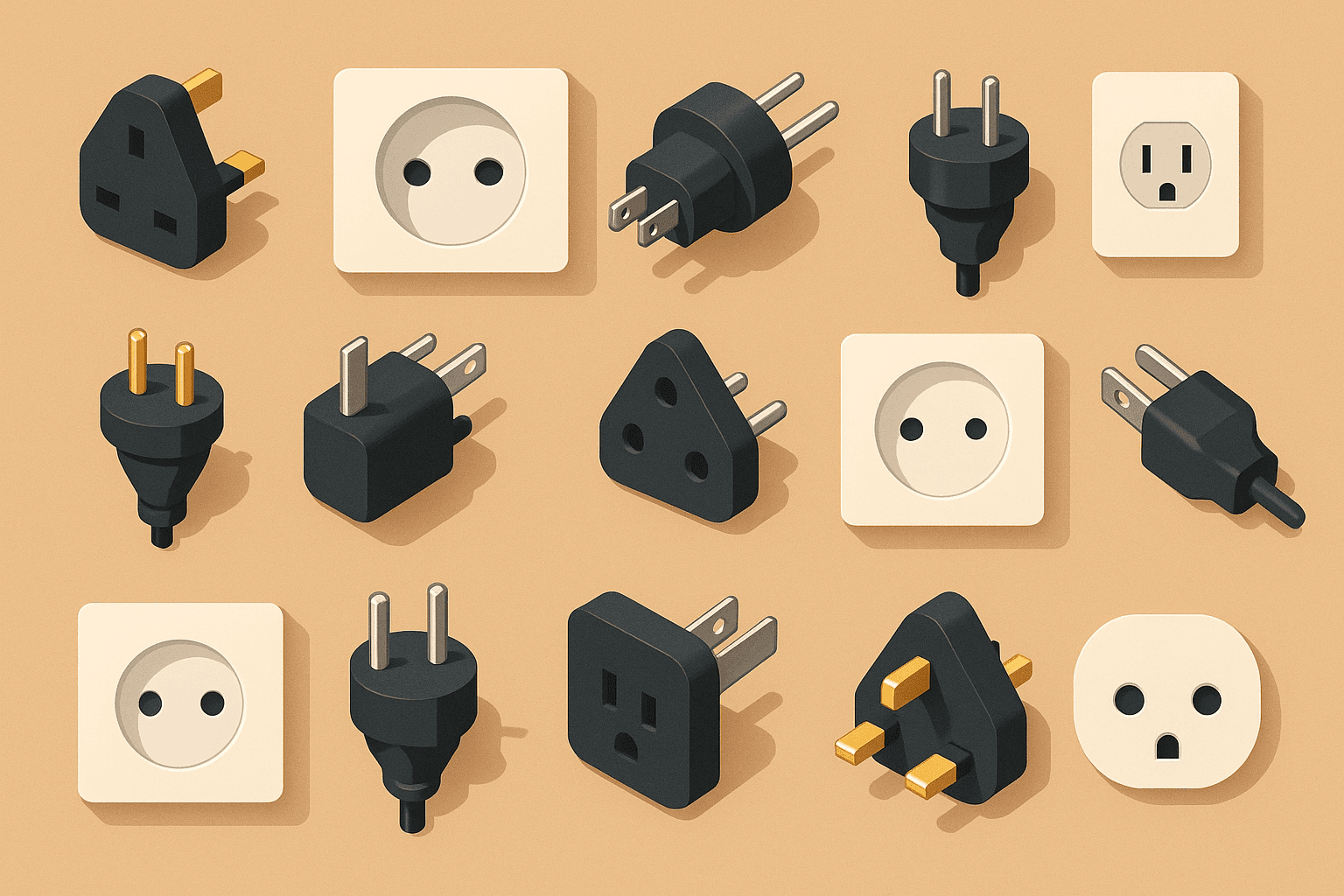
You reach a hotel in another country, pull out your phone charger, and discover it won't fit the wall. You hunt for an adapter, and then comes the second surprise: even if you manage to plug it in, the voltage may not be the same as back home. It is one of the most universal annoyances of travel, and behind it lie more than a century of history, industrial rivalries and decisions that can no longer be undone. This is why power plugs are different in every country.
A Tower of Babel of plugs
Around 15 domestic plug types coexist in the world today, labeled with letters running from A to O. That naming did not come from any global body: the United States International Trade Administration assigned it, alphabetically cataloguing the designs that already existed. The most common are North America's Type A/B —those two (or three) flat blades—, the two-round-pin Type C of most of continental Europe and South America, and Britain's Type G, that chunky three-rectangular-pin brick.
Why so much variety? For a very simple reason: when electricity reached homes in the late 1800s and early 1900s, there was no international coordination at all. Each city, each power company and each country wired its grid however it saw fit, inventing its own plugs and sockets from whatever was at hand. By the time anyone thought of agreeing on a standard, it was too late: millions of homes were already wired, and switching meant redoing everything.
The voltage feud: 110 versus 220
The first great fork was voltage, and it grows out of the same fight told in other chapters of electricity: the war of the currents between Thomas Edison and Nikola Tesla. Edison built the first grids in the United States in the 1880s delivering 110 volts, and that number was burned into North American wiring. Today the United States and much of the Americas get around 120 V at the socket.
Europe also started near 110 V, but years later jumped to 220–240 V. The reason was economic: at a higher voltage you can deliver the same power with less current, and less current allows thinner wires. Since copper has always been expensive, doubling the voltage was a way to save metal across the whole grid. The United States, which already had millions of appliances running on 110 V, preferred not to move its standard. So the world split in two: most of it on 220–240 V, North America on 120 V.
50 or 60 hertz: another 19th-century inheritance
As if two voltages were not enough, we also inherited two frequencies. In 1891, at almost the same moment, Westinghouse engineers in Pittsburgh chose 60 hertz for their alternating current, while those at Germany's AEG in Berlin settled on 50 hertz. The European figure fit the metric decimal system better; the Americans reckoned their lighting equipment ran a little better at 60 Hz. Neither was clearly superior, and yet that ten-cycle difference survives untouched 135 years later.
The best example of how arbitrary it all is comes from Japan, which ended up split down the middle. In the late 1800s, Tokyo bought German AEG generators (50 Hz) and Osaka bought American General Electric generators (60 Hz). The country never unified the two grids: to this day eastern Japan runs at 50 Hz and western Japan at 60 Hz, with special stations to convert power from one half to the other.
Colonialism, plugged in
If you look at a map of plug types, you notice something curious: neighboring countries sometimes use different systems, and far-flung countries use the same one. The explanation is usually colonial history. As the European powers electrified their colonies, they exported their plugs and voltages too. Much of Africa, Asia and the Caribbean uses the British three-pin plug simply because it was part of the British Empire; many former French colonies inherited the French Type E.
That is why the electrical map of the world looks so much like an old map of empires. The plug in your wall is, in a sense, a fingerprint of who built your country's first power grid. It is the same pattern other technologies left as they traveled the world, like the USB-C standard now trying, at last, to unify chargers.
The British plug, a child of the war
Among all the designs, Britain's Type G deserves its own paragraph, because it is a direct child of the Second World War. When the conflict ended, Britain had two enormous problems: a lot of housing destroyed by bombing and a chronic copper shortage, drained by the war effort. It had to rebuild and wire homes using as little metal as possible.
The solution, published as standard BS 1363 in 1947, was ingenious. Instead of running a separate cable to each socket, electricians wired the outlets of a room or a whole floor into a ring circuit, a loop that used far less copper. But a thinner cable in a ring could be overloaded, so safety was moved into the plug itself: every British plug carries a fuse inside that cuts it off if something goes wrong. That is why the Type G is so bulky and also one of the safest in the world: its size is, quite literally, a postwar scar.
Why there will never be a universal plug
The obvious question is: if all this is a mess, why not adopt a single plug for the whole planet? People tried. In 1963 the Europlug (Type C) was born, a flat two-round-pin plug meant as a common European solution for low-power devices; today it is the most widely used plug in the world. But it only works for small things and never solved the underlying problem.
And the underlying problem is pure inertia. Replacing a country's standard would mean changing the sockets of millions of buildings, plus the plugs of every appliance that already exists, and probably the grid's voltage and frequency too. The cost would be astronomical and the benefit barely a convenience for travelers. So we keep hauling adapters around, trapped by choices some engineers made more than a hundred years ago, never imagining the whole world would end up plugged in. Sometimes technology does not move toward what is best, but toward what is already installed.
References
- "Mains electricity by country," Wikipedia. en.wikipedia.org
- "BS 1363," Wikipedia. en.wikipedia.org
- "Utility frequency," Wikipedia. en.wikipedia.org
- "Why do different countries have different electric outlet plugs?," UF Warrington College of Business. warrington.ufl.edu
Do you enjoy these everyday technologies almost nobody understands? Continue with the war of the currents between Edison and Tesla or explore the whole science and tech section.
Categories
The books · born from this blog
Atahualpa con su abrigo de pelo de murciélago
y otras 49 historias verdaderas que parecen mentira
Available on Amazon
Tocar madera
Pequeña historia de las supersticiones que el mundo no ha podido soltar
Available on Amazon
100 futuros
Cien escenarios del mundo que viene con la inteligencia artificial
Available on AmazonYou may also like

Why veins look blue when your blood is red
Human blood is never blue—it is always red. So why do veins look blue under the skin? The answer lies in how light travels through your body and how you see.

The nocebo effect: when expecting harm creates it
The nocebo effect is the placebo's dark twin: believing a treatment will hurt can make it hurt. Its origin, real cases and what science says.

The History of the Match: Fire in Your Pocket
The friction match was born by accident in 1826, poisoned thousands of factory women, and only later became the safe fire we carry in our pocket.