
The History of the Mouse: From Wood Block to Gesture
The mouse was born in 1964 as a wooden block with two wheels. This is the story of how it went from a lab bench to your desk and then vanished.
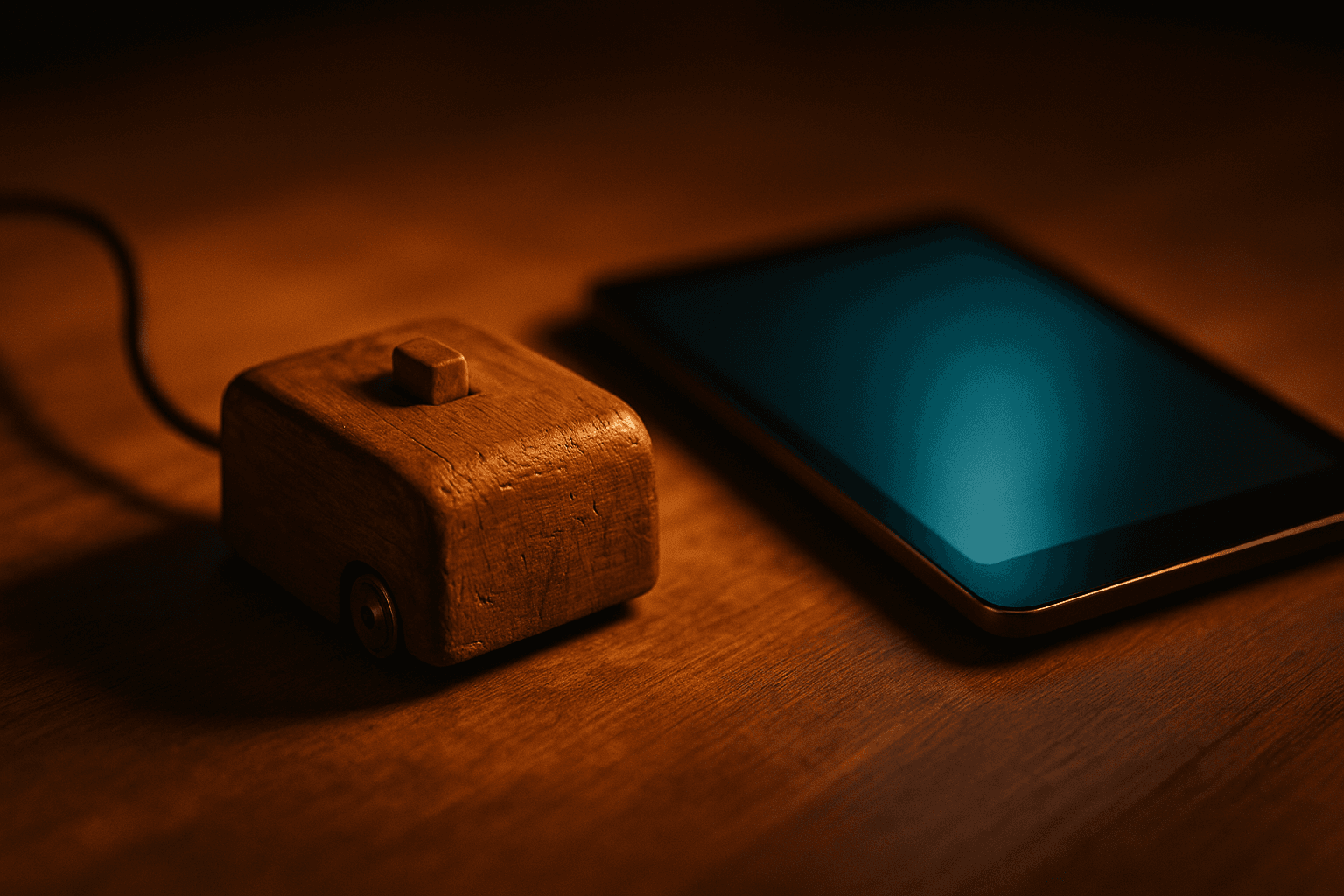
Today we move a cursor without thinking about it: we slide a finger across a sheet of glass, "pinch" to zoom a photo, or push a pointer around the screen without even looking at our hand. It's hard to imagine that all of it began with a crude wooden block holding two metal wheels and a cable that trailed out the back like a tail. That hand-built box from 1964 was the first computer mouse in history, and its journey —from a California lab to the touchscreen in your pocket— is also the story of how we learned to talk to machines.
A wooden box for pointing at the screen
The mouse was born in the mind of Douglas Engelbart, an engineer at the Stanford Research Institute (SRI) obsessed with an idea that sounded like science fiction in the 1960s: that computers shouldn't be limited to crunching numbers, but should augment human intelligence by helping us think and work. For that he needed a comfortable way to point at things on a screen, something that simply didn't exist yet.
Engelbart jotted the idea in a notebook, but it was his colleague Bill English, the lab's chief engineer, who built the first prototype in 1964: a palm-sized wooden shell with two perpendicular metal wheels —one for horizontal movement, one for vertical— and a single button. As you pushed the box across the desk, the wheels turned and translated the motion into cursor movement. The gadget got its nickname in the lab itself: the cable came out the front, and someone thought it looked like a mouse's tail. The name stuck, though no one remembers exactly who said it first.
"The Mother of All Demos"
The world met the invention on December 9, 1968, in San Francisco, during a presentation history later dubbed "The Mother of All Demos." In front of hundreds of engineers, Engelbart sat at a screen and, with his wooden mouse, showed live things that had never been seen together before: windows, real-time text editing, video calling, hypertext (clickable links), and remote collaborative work. In 90 minutes it was a preview of almost all the personal computing that would arrive decades later.
The patent for the device had been filed in 1967 and granted in 1970, under a name with nothing charming about it: "X-Y Position Indicator for a Display System." Engelbart signed away the rights and, by his own account, received only a few thousand dollars for one of the most-copied ideas in technology. Like so many other pieces of this archaeology of machines, recognition came late; something similar happened to Ada Lovelace and the first computer program.
Xerox PARC swaps the wheels for a ball
In the early 1970s, Bill English left SRI and took the idea to the legendary Xerox PARC, the Palo Alto research center where much of modern computing was being invented. There the mouse made a key leap: the two metal wheels were replaced by a ball that rolled in any direction, its motion read by two internal rollers. It was more precise and smoother, and it's the mechanism many of us remember from the mice you had to open up to clean the lint out of.
The catch was the price. The mouse Xerox built into its Alto computer cost a fortune —hundreds of dollars— had three buttons, broke down often, and was hard to clean. Xerox held almost the entire future of personal computing in its hands and, for commercial reasons, failed to seize it, a story that echoes the way Unix spread across the world far from the company that first saw it born.
Apple: the $15 mouse that conquered the world
In 1979, a young Steve Jobs visited Xerox PARC and was captivated by that graphical interface driven by a mouse. Back at Apple, he handed the designers at the Hovey-Kelley studio (the seed of the future IDEO) a very specific challenge: build a mouse that cost a fraction of the Xerox one —he spoke of around $15— that worked reliably and was simple enough to mass-produce and clean easily.
The team pulled it off: a single button, a rubber ball over a steel one, and a far simpler, cheaper mechanism. That mouse shipped first with the expensive Lisa (1983), which flopped, and then with the Macintosh in 1984, which succeeded and made the graphical interface —and the mouse— the industry standard. From then on, typing on a keyboard and pointing with a mouse became the natural way to use a computer, as taken for granted as the letter order of the QWERTY keyboard.
From ball to light: the optical mouse
For almost two decades, the ball mouse reigned over the world's mousepads, with its inevitable ritual of popping it open to scrape gunk off the rollers. Change came in 1999, when Agilent (a spin-off from HP) developed an optical sensor that could read movement by photographing the surface hundreds of times a second, with no moving parts at all.
That same year, Microsoft launched the IntelliMouse Explorer using that technology: goodbye to the ball, the lint, and the special pad. Soon after came laser mice, more precise still, and the mouse stopped being a mechanical device and became a tiny eye staring at the desk. With no wheels or ball, the gadget turned nearly indestructible.
The invisible gesture: when the mouse disappeared
The final stage of this story is the disappearance of the object itself. Laptops had already added the trackpad, a touch-sensitive surface that stood in for a mouse. But the decisive leap came with the multi-touch screens of phones and tablets, starting in 2007: suddenly the hand pointed directly at the image, and gestures like the "pinch" to zoom or the swipe to turn a page made any intermediate device unnecessary.
The mouse hasn't died —it's still irreplaceable for designing, editing, or gaming with precision— but its essential function, pointing and selecting, has become an invisible gesture we make with a finger without thinking. That 1964 wooden box fulfilled, half a century later, Engelbart's dream: that the machine would step out of the way and leave only human intention behind. From the first computer that filled a room to the one we hold in our hand, the mouse was the bridge; if that journey interests you, continue with the debate over which was the first personal computer.
References
- "The computer mouse and interactive computing," SRI International. sri.com
- "Douglas Engelbart Invents the Computer Mouse," History of Information. historyofinformation.com
- "Mighty Mouse," Stanford Magazine. stanfordmag.org
- "Computer Mouse: Complete History," History-Computer. history-computer.com
Enjoy the hidden history of technology? Continue with Grace Hopper and the origin of the computer "bug" or explore the whole Science & Tech section.
Categories
The books · born from this blog

Atahualpa con su abrigo de pelo de murciélago
y otras 49 historias verdaderas que parecen mentira
Available on Amazon
Tocar madera
Pequeña historia de las supersticiones que el mundo no ha podido soltar
Available on Amazon
100 futuros
Cien escenarios del mundo que viene con la inteligencia artificial
Available on AmazonYou may also like

The History of the Match: Fire in Your Pocket
The friction match was born by accident in 1826, poisoned thousands of factory women, and only later became the safe fire we carry in our pocket.
The History of Ethernet: How an Office Learned to Share
In 1973, at Xerox PARC, an engineer wired an office's computers to a laser printer. That was the birth of Ethernet, the network we still use today.
The History of the Floppy Disk and the Save Icon
The floppy disk held 80 KB in 1971 and survives today as the «save» icon many young people never touched. This is the full history of the floppy disk.