
Inca Quipus: Accounting, Memory or Writing?
Inca quipus recorded data with knotted cords. Were they just accounting, a memory aid or a form of writing? Here is what scholars actually know today.
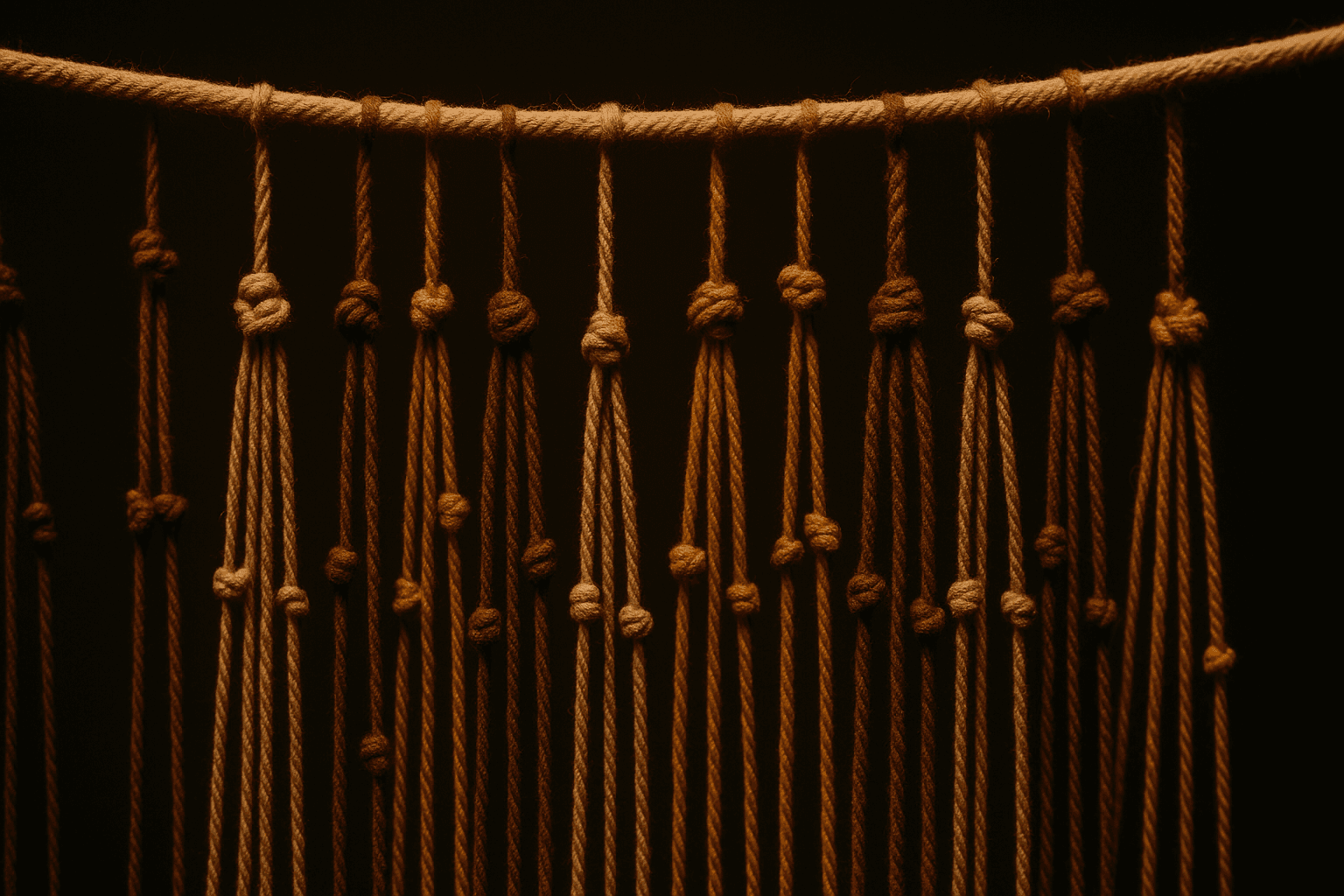
A quipu —or khipu, "knot" in Quechua, the language of the Inca empire— is a bundle of knotted cords that at first glance looks like a tangle of woolly fringe. And yet, with those knots the Tawantinsuyu administered an empire of millions: censuses, harvests, tribute, armies. One big question has stayed open for more than a century: were quipus just an accounting device, a memory aid for whoever recited them, or a genuine writing system made of thread?
What exactly a quipu is
A quipu is built from a horizontal primary cord from which dozens —sometimes hundreds— of pendant cords hang, which in turn may carry subsidiary cords. They are made of cotton or camelid fiber (llama, alpaca), dyed in different colors, and the information is encoded in three variables: the type and position of the knots, the color of the cord, and the way each thread is attached to the main one.
The people who made and "read" them were specialized officials, the quipucamayocs (khipukamayuq, "the keeper of the knots"). They formed a caste of accountants and archivists of the Inca state, trained from childhood. Today about 1,400 quipus are known, scattered across more than 140 museum and private collections, from California to Sweden.
Accounting: what we can actually read
The numerical layer of the quipu is essentially deciphered, and has been for over a century. In 1912, the researcher L. Leland Locke showed that the knots encode numbers in a decimal, place-value system, the same principle our own numerals use: the position of the knot along the cord tells you whether it stands for ones, tens, hundreds or thousands.
The cluster of knots farthest from the primary cord represents the ones; the next one up, the tens; then the hundreds, and so on. There are three knot types: the long knot (with two to nine turns) marks the units from 2 to 9; a figure-eight knot stands for exactly 1; and the single knot is used in the tens position and above. The absence of a knot in a position works as a zero: an empty gap on the cord. That is why, when a quipu records quantities, specialists can read it with real confidence.
Memory: cords that were recited
The trouble is that the Spanish chroniclers of the sixteenth century did not describe the quipucamayocs merely adding up harvests. They described them narrating: reciting royal genealogies, lists of battles, songs, myths and laws while running the cords through their fingers. If quipus only held numbers, how did whole histories come out of them?
For decades the safest answer was that many quipus worked as a mnemonic aid: the knots did not "spell out" the story but served as a script for a memory that had been trained in advance, the way a rosary helps recall a sequence of prayers without containing their words. The content lived in the quipucamayoc's head; the cord only ordered and triggered it. It is the same border that separates counting from writing down a procedure with symbols: recording a figure is not the same as recording a language.
Writing? The frontier that is shifting
The most ambitious hypothesis is that at least some quipus encode language, not just quantities or simple reminders. The anthropologist Gary Urton, of Harvard University, proposed that each cord contains a series of binary decisions —fiber type, spin and knot direction (the so-called "S" or "Z" knots), color, position— that together could form a system of signs able to record words. To investigate it he founded Harvard's Khipu Database Project, now inscribed in UNESCO's Memory of the World register.
The most cited case came in 2017, when Manuel Medrano, then a first-year student working with Urton, compared six quipus from the Santa Valley with a colonial tribute census from 1670. He found that the knot sums matched the assessed tribute and, above all, that the way each cord was attached to the main one —facing forward or backward— seemed to indicate which social moiety (hanan or hurin) each villager belonged to. In other words: the cords were not just counting people, they were beginning to identify them. Even so, no "non-numerical" quipu has been read in full, and most specialists remain cautious: between being a full writing system and being very sophisticated accounting there is still an undeciphered stretch.
Why so few survive
Part of the reason the puzzle stays open is deliberate destruction. In 1583, the Third Council of Lima ordered the burning of quipus tied to "idolatrous" rites, regarding them as an obstacle to conversion —though, paradoxically, the Church also promoted quipus adapted to keep track of confessions and prayers. Added to rotting cotton and looting, that colonial bonfire explains why only a little over a thousand cords survive from an entire empire.
So the honest answer to the question in the title is: all three, and we still do not fully know. The accounting is deciphered; the memory function is documented by the chroniclers themselves; and the possibility that they are writing is the frontier where archaeologists and algorithms work today. As with so many traces of the Andean world that outlived the Conquest, quipus still keep, in their knots, secrets we have not finished untying.
References
- «Quipu», Wikipedia. en.wikipedia.org
- «The Inka khipu», Smarthistory. smarthistory.org
- «The College Student Who Decoded the Data Hidden in Inca Knots», Atlas Obscura. atlasobscura.com
- «The Khipu Database (Khipu Archives) — Memory of the World», UNESCO. unesco.org
Enjoy stories from the Andean past? Continue with the Quechua we speak without knowing it or explore the whole history section.
Categories
The books · born from this blog
Atahualpa con su abrigo de pelo de murciélago
y otras 49 historias verdaderas que parecen mentira
Available on Amazon
Tocar madera
Pequeña historia de las supersticiones que el mundo no ha podido soltar
Available on Amazon
100 futuros
Cien escenarios del mundo que viene con la inteligencia artificial
Available on AmazonYou may also like
Cancha: from Inca enclosure to soccer field
«Cancha» comes from the Quechua kancha, the walled enclosure of the Incas. Here is how it went from temples and corrals to naming soccer fields across half the world.
Rubber Before Goodyear: The Gum That Melted
Before vulcanization, rubber was a gum that melted in summer and cracked in winter. From the Maya to Goodyear, here's how it was finally tamed.
Porcelain: the Chinese secret Europe tried to steal
For centuries Europe paid fortunes for Chinese porcelain without knowing how it was made. This is the story of a hundred-year industrial espionage.