
Why Roman Numerals Are So Clumsy for Arithmetic
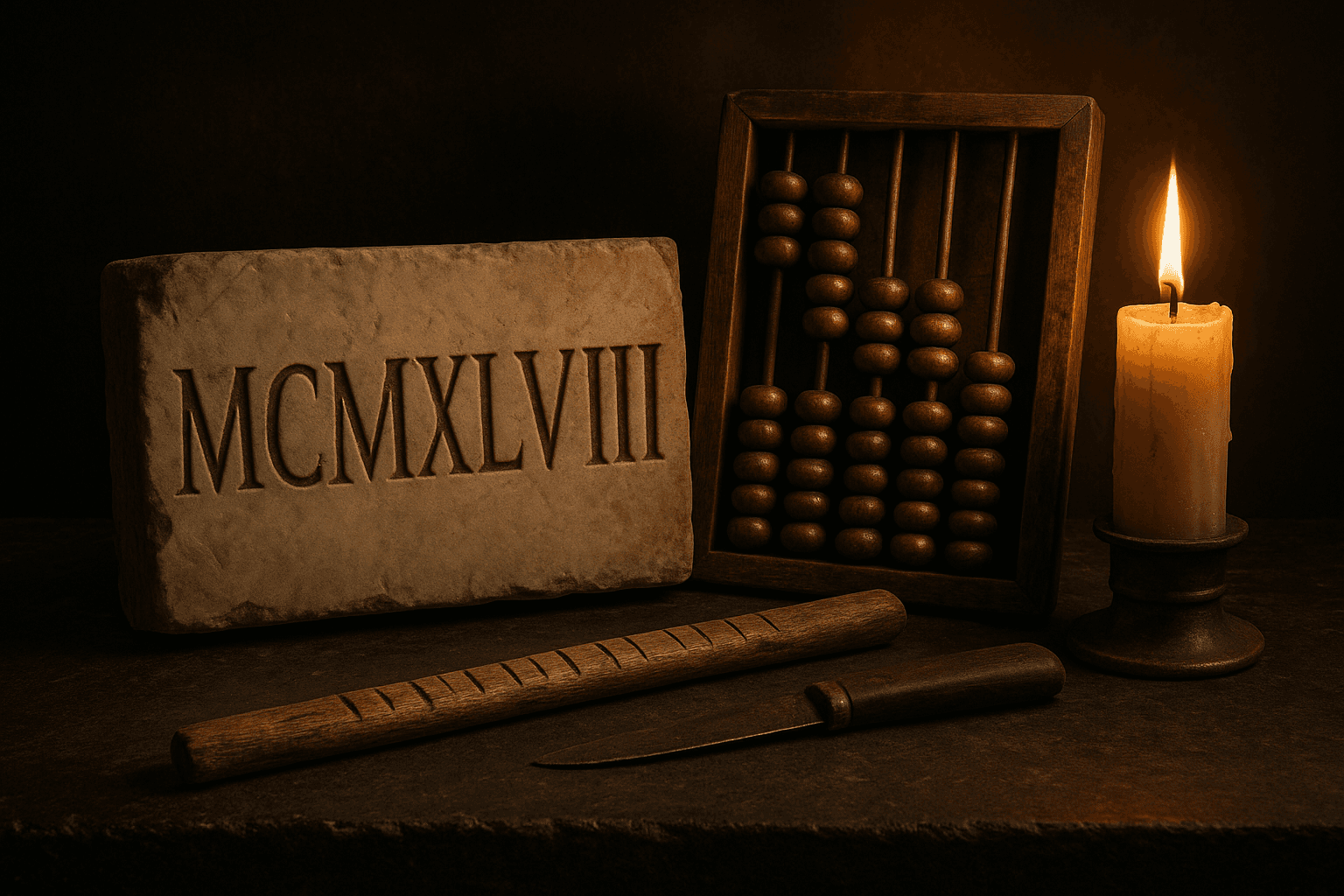
MCMXLVIII does not lend itself to adding or multiplying. Why Roman numerals, so good for carving in stone, were a disaster for calculation.
Try to multiply XXIV by LVIII with pencil and paper, without translating to modern numbers. It is not that it is hard: it is that there is nowhere to begin. Roman numerals look elegant on the façade of a building or in a film's credits, but for doing sums they are so clumsy that the Romans themselves almost never used them to calculate. The interesting question is not why we abandoned them, but how a people that built aqueducts and accounted for an entire empire managed with a number system so impractical.
Numbers born from notches on a stick
Before they were letters, Roman numerals were marks. The most widely accepted theory is that they descend from the notches shepherds carved with a knife into a stick to count livestock: one line per animal, a cut shaped like a V every five, and an X every ten. Shepherds in the Alps and Dalmatia went on using such tally sticks into the 19th century, with the same logic: the I was the basic cut, and grouping in fives and tens spared you from counting scratches one by one.
In time those marks were identified with letters of the alphabet —I, V, X, L, C, D, M— and the system was refined, but it never stopped being what it was at the start: a way to record quantities, not to operate on them. It is an additive system, made to be read and engraved, inherited partly from the Etruscans who dominated Italy before Rome. And there lies the first clue to its clumsiness: it was designed for stone and wax, not for arithmetic.
The problem of place value (and the missing zero)
Our current system is positional: the same symbol "2" is worth two, twenty or two hundred depending on the place it occupies. That is the magic that lets us add in columns and "carry" a digit to the next one. The Roman system does not work that way. In MMXXII each symbol is always worth the same wherever it sits, and to know the total you have to add them all up in your head. There are no aligned columns of units, tens and hundreds; there is nothing to "carry".
And the piece that makes place value possible is missing: zero. The Romans had no symbol for nothing because they did not need one in an additive notation —you do not have to mark "zero tens" when you are not writing tens in a column. That gap, which strikes us as an enormous shortcoming, was simply irrelevant to them. The story of how Europe ended up adopting zero is fascinating in itself: we tell it in the origin of the words "cipher" and "zero", two terms that were born from the same Arabic emptiness, and in why there is no year zero, a mistake that still complicates calendars and centuries.
The subtraction that complicates reading: IV versus IIII
Another source of clumsiness is subtractive notation, the rule by which IV is 4 (one before five) and IX is 9 (one before ten). It looks like an elegant saving, but it forces you to read a number looking forward and backward at once: on seeing an I you must check which symbol follows it to know whether it adds or subtracts. In ancient Roman texts that rule was not even fixed. For centuries it coexisted with the purely additive form IIII, which still survives on many clock faces. It is even said that IIII was preferred because IV were the first letters of IVPITER (Jupiter), though it was probably more a matter of visual symmetry than piety. Subtractive notation only became universal in modern times.
So how did the Romans calculate?
The answer dismantles the myth: the Romans did not do arithmetic with their numbers. To add, subtract, multiply or change money they used an abacus, a small board with grooves and sliding beads inherited from Greek counting boards, such as the Salamis Tablet of the 4th century BCE. The abacus was positional: each column stood for units, tens, hundreds, and an empty column played, without saying so, the role of zero. The calculation happened in the beads; the Roman numerals only served to record the result once it was done. Engraving "MMXXII" in a ledger was fine; trying to operate on that string of letters was not.
That explains the paradox of an empire that administered taxes, legions and land registries with a number system apparently useless for mathematics: the real mathematics was done by hands on the abacus. The written numbers were merely the memory of the calculation, not its tool.
The day the digits that actually calculate arrived
The turn came from the East. The so-called Arabic numerals —in fact of Indian origin, transmitted by Arab mathematicians along with zero and the concept of algorithm we owe to al-Khwarizmi— brought exactly what the Roman system lacked: place value and a symbol for nothing. With them you could add and multiply on paper, without an abacus.
In 1202, the mathematician Leonardo of Pisa, Fibonacci, published the Liber Abaci and showed European merchants how to use those figures to keep accounts, convert currencies and calculate profits. Adoption was slow —some cities even banned the new digits for fear of fraud— but unstoppable. Roman numerals, so good at lasting in stone, lost the one battle that mattered: doing sums. Today they survive where their clumsiness does no harm —clocks, volumes, kings, Super Bowls— and remind us that, like the Roman calendar that left September meaning "seven" in the ninth month, many oddities we carry are fossils of decisions made two thousand years ago.
References
- "Roman numerals", Wikipedia: origin in the notches of tally sticks, the symbols I, V, X and the subtractive notation (IV versus IIII) that only became universal in modern times. en.wikipedia.org
- "Roman Numerals: Their Origins, Impact, and Limitations", Encyclopedia.com: the absence of zero and of place value that made arithmetic difficult and hindered mathematical progress. encyclopedia.com
- "Roman abacus", Wikipedia: how the Romans actually calculated, with a positional abacus inherited from Greek counting boards, not with their written numbers. en.wikipedia.org
- "Liber Abaci", Wikipedia: Fibonacci's work (1202) that introduced Hindu-Arabic numerals and zero to European merchants, gradually displacing the Roman ones. en.wikipedia.org
Enjoy these stories of numbers and words? Continue with the origin of "cipher" and "zero" and that of "algorithm", or browse the whole history section.
Categories
The books · born from this blog

Atahualpa con su abrigo de pelo de murciélago
y otras 49 historias verdaderas que parecen mentira
Available on Amazon
Tocar madera
Pequeña historia de las supersticiones que el mundo no ha podido soltar
Available on Amazon
100 futuros
Cien escenarios del mundo que viene con la inteligencia artificial
Available on AmazonYou may also like

Rubber Before Goodyear: The Gum That Melted
Before vulcanization, rubber was a gum that melted in summer and cracked in winter. From the Maya to Goodyear, here's how it was finally tamed.

Porcelain: the Chinese secret Europe tried to steal
For centuries Europe paid fortunes for Chinese porcelain without knowing how it was made. This is the story of a hundred-year industrial espionage.

The History of Glass: The Material That Changed the World
Glass went from Egyptian luxury to everyday object thanks to Roman glassblowers, and later gave science its telescope and microscope.